


A facial mist for sun is a sprayable product that delivers a stated SPF rating and light hydration in seconds. It is designed primarily for reapplication over makeup during the day, not as a replacement for your morning base sunscreen.
Quick takeaways:
- SPF facial mists are most useful for midday reapplication, especially over makeup.
- They work best when paired with a full broad-spectrum sunscreen applied in the morning.
- Hold the bottle a moderate distance from your face and pat the product in after spraying.
- Watch for inhalation warnings on aerosol labels and avoid spraying in enclosed spaces.
- They add surface moisture but do not lock it in. Dry skin types should follow up with a moisturizer.
Table of Contents
- How does an SPF facial mist actually protect your skin?
- The real benefits of SPF facial mists for everyday use
- Limitations and common misconceptions about SPF mists
- How to apply an SPF facial mist for even coverage
- Choosing the right SPF level and reading spray labels
- Key ingredients in SPF facial mists and what they do
- Who benefits most from SPF facial mists?
- Research-backed reasons mists improve real-world sun protection
- Safety tips and U.S. regulatory notes for spray sunscreens
- Key Takeaways
- SPF mists work, but only if you use them right
- Miamibeachbum Save Face SPF 50 fits exactly this routine
- Useful sources
How does an SPF facial mist actually protect your skin?
An SPF facial mist works the same way a lotion sunscreen does at the chemistry level. Active filters, either mineral (zinc oxide, titanium dioxide) or chemical, form a thin film on the skin surface that absorbs or reflects UV radiation. The SPF number tells you how much UVB protection that film provides. Broad-spectrum labeling means the product also protects against UVA rays, which drive skin aging and long-term damage.
The practical difference from a lotion is film formation. A spray must land evenly across the entire face to deliver its stated SPF. Uneven distribution means patchy protection. That is why technique matters as much as the product itself.
Key protection points:
- Physical filters reflect UV; chemical filters absorb it and convert it to heat.
- Broad-spectrum coverage requires both UVA and UVB protection.
- Film evenness determines whether the labeled SPF is what your skin actually receives.
The real benefits of SPF facial mists for everyday use
The biggest practical advantage is speed. A mist applies quickly, encouraging consistent use. Reapplication compliance is one of the weakest points in real-world sun protection, and anything that removes friction from that step improves outcomes.

Makeup compatibility is the second major benefit. Most lotions disturb foundation and powder. A fine mist, applied at the right distance, refreshes the skin and sets makeup rather than disrupting it. This makes SPF mists the most practical midday reapplication option for anyone wearing makeup.
Beyond protection, modern mist formulas have moved well past plain water. Many now function as sprayable serums with niacinamide, antioxidants, and humectants that deliver skin-care benefits throughout the day. The cooling effect is real too. A quick spritz on heat-flushed skin reduces surface temperature and revives tired skin fast.
Pro Tip: Use an SPF mist immediately after outdoor exercise or any activity that causes heavy sweating. Sweat breaks down sunscreen film, and a mist reapplication takes less time than finding a bathroom to wash and reapply.
Limitations and common misconceptions about SPF mists
The most common mistake is treating a mist as a full-day sunscreen applied once in the morning. It is not. The same two-hour reapplication rule that applies to any sunscreen applies to mists. Sustained sun exposure requires regular reapplication regardless of the delivery format.
Coverage gaps are a real risk with sprays. If you rush the application or hold the bottle too close, you get large droplets and missed areas. A mist also cannot compensate for skipping a base sunscreen entirely. Think of it as a maintenance tool, not a foundation.
Other limitations to know:
- Surface hydration only. A mist adds moisture to the skin surface but does not seal it in. In dry environments, humectants like hyaluronic acid can actually pull moisture away from skin if no moisturizer follows.
- Inhalation risk. Aerosol and pump sprays should never be directed at the mouth or nose. Spray into your hands first if applying near those areas.
- Flammability. Many aerosol formulas carry flammability warnings. Store away from heat and open flames.
- Sensitive skin. High-alcohol formulas can irritate reactive skin types.
How to apply an SPF facial mist for even coverage
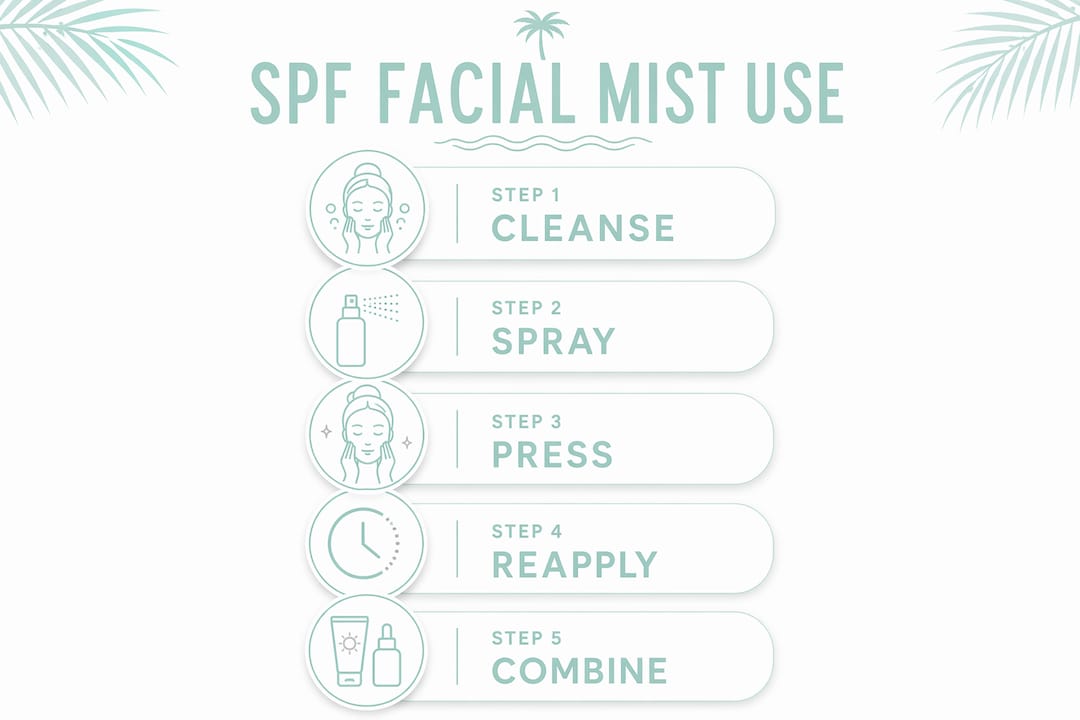
Technique determines whether you get the SPF the label promises or a patchy result. Follow these steps for consistent coverage:
- Hold the bottle 8–12 inches from your face. Closer than that produces large droplets and uneven distribution.
- Spray in an “X” and “T” pattern. The X covers cheeks and forehead diagonally; the T covers the center strip from forehead to chin. Together they cover the full face.
- Press the mist into your skin with clean hands. This step is critical. Patting the product in improves adhesion, eliminates visible droplets, and prevents streaking over makeup.
- Reapply every two hours during sun exposure. After towel-drying or heavy sweating, reapply immediately regardless of timing.
- Apply over or under makeup as needed. Over makeup for midday touch-ups; under makeup in the morning as part of your base routine if the formula suits your skin.
Pro Tip: After spraying, a quick press with your fingertips across the nose bridge, temples, and jawline catches any spots the spray pattern missed. These areas are easy to skip and among the first to burn.

Choosing the right SPF level and reading spray labels
Dermatologists consistently recommend SPF 30 as the minimum for daily face use. SPF 30 blocks most UVB rays; SPF 50 blocks slightly more. The gap is small, but for a face that sees incidental sun daily, SPF 50 is a reasonable choice. For extended outdoor exposure, SPF 50 or higher is worth the marginal difference.
Label checklist before you buy:
| Label Claim | What It Means | What to Check |
|---|---|---|
| Broad spectrum | Protects against UVA and UVB | Required for anti-aging and cancer protection |
| SPF 30+ | Blocks most UVB rays | Minimum for daily face use |
| Water resistant (40 or 80 min) | Maintains SPF after water exposure | Relevant for beach, pool, or heavy sweating |
| Active ingredients listed | Names the actual UV filters | Verify mineral vs. chemical |
| Dermatologist tested | Tested for tolerability | Not the same as clinical efficacy data |
| Inhalation warning | Aerosol safety notice | Follow instructions; spray outdoors or in ventilated spaces |
Water-resistance claims come in two versions: 40 minutes and 80 minutes. Neither means waterproof. Reapply after the stated window. For a daily commute or desk job, water resistance is less relevant than for beach or pool use.
Key ingredients in SPF facial mists and what they do
Active filters are the core of any SPF product. In mists, you will typically find one of two types. Mineral filters, zinc oxide and titanium dioxide, sit on the skin surface and physically scatter UV. Chemical filters, such as avobenzone, octinoxate, or homosalate, absorb UV energy and release it as heat. Mineral filters are generally better tolerated by sensitive skin. For a deeper look at how these filters compare, chemical vs. mineral sunscreen differences are worth understanding before you buy.
Beyond the filters, modern mist formulas commonly include:
- Glycerin and hyaluronic acid (humectants): draw water to the skin surface for immediate hydration.
- Niacinamide: supports the skin barrier and can reduce redness over time.
- Antioxidants (vitamin C, vitamin E, green tea extract): neutralize free radicals generated by UV exposure.
- Botanical actives: some formulas include botanical ingredients like plant extracts that add soothing or brightening effects.
For sensitive or reactive skin, check for high denatured alcohol content and added fragrance. Both can cause irritation, especially with repeated daily application. Alcohol-free, fragrance-free formulas are the safer starting point.
Who benefits most from SPF facial mists?
SPF mists are not for every situation, but they fit a specific set of users and use cases well.
Best fits:
- People who wear makeup daily and need a practical midday reapplication method.
- Anyone with an active outdoor lifestyle who sweats through lotion sunscreen.
- Travelers and commuters who want a compact, quick-apply option.
- Those with oily or combination skin who find lotion sunscreens too heavy.
When to pair or skip:
- Very dry skin: use a mist but follow with a moisturizer like Skin Smoothie to seal in hydration.
- Sensitive or reactive skin: avoid high-alcohol sprays; choose mineral-filter formulas.
- Infants and very young children: stick to pediatrician-recommended lotion sunscreens.
- All-day beach or outdoor exposure: a mist alone is not enough. Start with a full base sunscreen and use the mist for reapplication.
Common use cases: commuting, outdoor dining, travel, post-exercise refreshes, and beach touch-ups between swims.
Research-backed reasons mists improve real-world sun protection
The science of sun protection has always had a compliance problem. People apply sunscreen in the morning and skip reapplication. The two-hour reapplication window is well established, but it requires carrying a product and taking the time to use it. Mists reduce both barriers.
Dermatology-focused experts note that convenience and makeup compatibility are the two factors most likely to change reapplication behavior. A product that takes ten seconds and does not disturb makeup removes the two most common reasons people skip midday reapplication. The result is more consistent SPF coverage throughout the day, which is more protective than a single high-SPF morning application that wears off.
Formulation advances reinforce this. High-quality mists now deliver vitamins, antioxidants, and humectants in a single spritz, so the product earns its place in a routine beyond just sun protection. Pairing a broad-spectrum SPF 30–50 sunscreen in the morning with mist reapplications midday is the most practical approach for most people.
Pro Tip: Set a phone reminder at the two-hour mark when you know you will be outdoors. The mist takes ten seconds. The reminder is the harder part.
Safety tips and U.S. regulatory notes for spray sunscreens
In the United States, sunscreens are regulated as over-the-counter drugs by the FDA. That means the active ingredients must be listed by name on the label, and claims like “broad spectrum” and “water resistant” must meet defined testing standards. When you pick up a spray sunscreen, the active ingredient panel is the most important section to read.
Practical safety checklist:
- Spray outdoors or in a well-ventilated space. Never use aerosol sprays in an enclosed room.
- Do not spray directly onto the face. Spray into your hands, then apply, or close your eyes and mouth before misting.
- Keep aerosol cans away from heat sources and open flames. Flammability warnings on the label are not decorative.
- Patch-test new formulas on the inner arm before applying to the full face, especially for sensitive skin.
- If a spray sunscreen does not list active ingredients by name, that is a red flag. Skip it.
- When in doubt about a formula for children or compromised skin, choose a lotion with a clear mineral-filter label.
Key Takeaways
SPF facial mists are a practical reapplication tool that work best alongside a full broad-spectrum base sunscreen applied every morning.
| Point | Details |
|---|---|
| Mists are reapplication tools | They maintain SPF throughout the day; they do not replace a morning base sunscreen. |
| Technique determines coverage | Hold 8–12 inches away, spray in X and T patterns, then pat in with clean hands. |
| Look for broad-spectrum SPF 30+ | Broad-spectrum labeling covers both UVA and UVB; SPF 30 is the daily minimum. |
| Dry skin needs a follow-up step | Mists add surface moisture only; seal with a moisturizer to prevent dehydration. |
| Miamibeachbum Save Face SPF 50 | A mineral-filter facial serum designed for daily wear and makeup-friendly reapplication. |
SPF mists work, but only if you use them right
The conventional wisdom on facial mists tends to split into two camps: either they are a gimmick or they are a complete sun-care solution. Both are wrong. A mist is a specific tool for a specific job, and it does that job well when used correctly.
The part most people underestimate is the behavior change. A product that takes ten seconds and does not disturb your makeup is one you will actually use at noon. That consistency matters more than the difference between SPF 30 and SPF 50 on a label. A well-applied SPF 30 reapplied twice beats a single morning application of SPF 50 that wears off by 10 AM.
Where mists fall short is as a standalone solution for serious sun exposure. A day at the beach, a long hike, or any activity involving water and sweat requires a proper base sunscreen first. The mist handles maintenance; it does not handle the foundation.
Miamibeachbum Save Face SPF 50 fits exactly this routine
Miamibeachbum’s Save Face SPF 50 Sheer Mineral Facial Serum is built for the use cases covered in this article: daily wear, makeup-friendly application, and a mineral-filter formula that works for sensitive skin. SPF 50 broad-spectrum protection in a sheer serum format means it layers cleanly under or over makeup without the white cast common to heavier mineral products.
For readers who want to build a complete sun-care routine, pairing Save Face with a full-body option from the Miamibeachbum bodycare range covers both face and body in one brand. Check the product label for active ingredient details and usage instructions specific to your skin type.
Useful sources
- Do Face Mists Actually Do Anything? | British Vogue: Expert quotes and formulation analysis on modern mist ingredients and application technique.
- How To Use Face Mist | BeautyComfy: Practical application guidance including distance, patting technique, and reapplication timing.
- The Science Behind the Seal | Skin Cancer Foundation: Authoritative explanation of broad-spectrum labeling and what SPF ratings mean.
- 5 Secrets of Sunscreen Users | Skin Cancer Foundation: Data on real-world sunscreen use habits and reapplication behavior in the U.S.
- How, When and Why Use a Face Mist | Pestle & Mortar: Practical routine guidance on when to insert a mist into a skin-care sequence.
- How to Use Face Mist for a Radiant Complexion | Yon-Ka US: Application sequencing advice including the damp-skin absorption technique.
- Save Face SPF 50 Sheer Mineral Facial Serum | Miamibeachbum: Product page for the brand’s mineral facial SPF option.