


SPF 30 is sufficient for most daily and incidental sun exposure. SPF 50 is the better choice for prolonged outdoor activity, high-UV environments, or anyone at elevated skin cancer risk. The numeric difference is smaller than most people expect: SPF 30 blocks approximately 97% of UVB rays, while SPF 50 blocks approximately 98%.
Quick use-case guide:
- Daily/incidental exposure (commuting, errands, brief outdoor time): SPF 30 is adequate.
- Prolonged outdoor activity (beach, hiking, sports, yard work): SPF 50 or higher.
- High-risk individuals (skin cancer history, photosensitizing medications, melasma, immunosuppression): SPF 50 or higher, per dermatologist guidance.
Key Takeaways
| Point | Details |
|---|---|
| SPF 30 for daily use | SPF 30 blocks ~97% of UVB rays and meets AAD standards for everyday protection. |
| SPF 50 for extended outdoor or high-risk | Choose SPF 50 for beach days, sports, reflective environments, or if you have a skin cancer history. |
| Reapply every two hours | Reapplication after swimming, sweating, or toweling off is as important as the SPF number you choose. |
| Broad spectrum is non-negotiable | UVA protection requires the broad-spectrum label; SPF alone does not cover it. |
| Miamibeachbum SPF 50 options | Blocked SPF50 (body spray) and Save Face SPF 50 Sheer Mineral Facial Serum cover both body and face needs. |
Table of Contents
- What does SPF actually measure?
- How do SPF 30 and SPF 50 actually compare?
- Why how you apply sunscreen matters more than the SPF number
- When should you choose SPF 50?
- How to choose a sunscreen beyond the SPF number
- What do dermatologists and major health organizations recommend?
- A practical checklist for applying sunscreen correctly
- An editorial note on the SPF 30 vs 50 decision
- Miamibeachbum’s SPF 50 options for when extra protection counts
- Sources
What does SPF actually measure?
SPF stands for Sun Protection Factor. It measures how well a sunscreen filters UVB rays, the wavelength primarily responsible for sunburn and a key contributor to skin cancer. It does not measure time outdoors, and it does not directly measure UVA protection.
The FDA’s SPF testing standard requires a lab application of 2 milligrams per square centimeter of skin. That is the condition under which every SPF number on a label was earned. Most people apply far less, which reduces the effective protection they actually receive.
Two things SPF does not cover on its own:
- UVA rays, which penetrate deeper into skin and are strongly linked to photoaging and certain skin cancers. UVA and UVB radiation both contribute to skin damage, but in different ways.
- Visible light, which can worsen pigmentary conditions like melasma in some people.
The “broad spectrum” label on a sunscreen bottle means the formula has passed FDA testing for UVA protection in addition to UVB. That label matters as much as the SPF number. A high SPF without broad-spectrum coverage leaves a significant gap.
Callout: SPF measures UVB filtration under ideal lab conditions. It says nothing about UVA coverage or how long you can stay in the sun.
How do SPF 30 and SPF 50 actually compare?
The math of SPF is not linear, and that is where most confusion starts.
| SPF | UVB Rays Blocked (Nominal) | UVB Rays That Reach Skin |
|---|---|---|
| 30 | ~97% | ~3% |
| 50 | ~98% | ~2% |
| 100 | 98% | ~1% |
That is meaningful in extended exposure scenarios. This is the classic diminishing-returns curve.
Stat callout: The difference between SPF 30 and SPF 50 is just 1 percentage point of UVB blocked. But in real-world conditions where people under-apply, that margin can translate to measurably fewer sunburns.
Field studies involving skiers and vacationers found that participants using higher-SPF products experienced fewer sunburns during extended outdoor exposure, even when application was imperfect.
Cost is also a factor. Higher-SPF products often carry a higher price tag relative to the incremental protection gain. For daily, low-exposure use, SPF 30 delivers strong protection at a lower cost.
Why how you apply sunscreen matters more than the SPF number
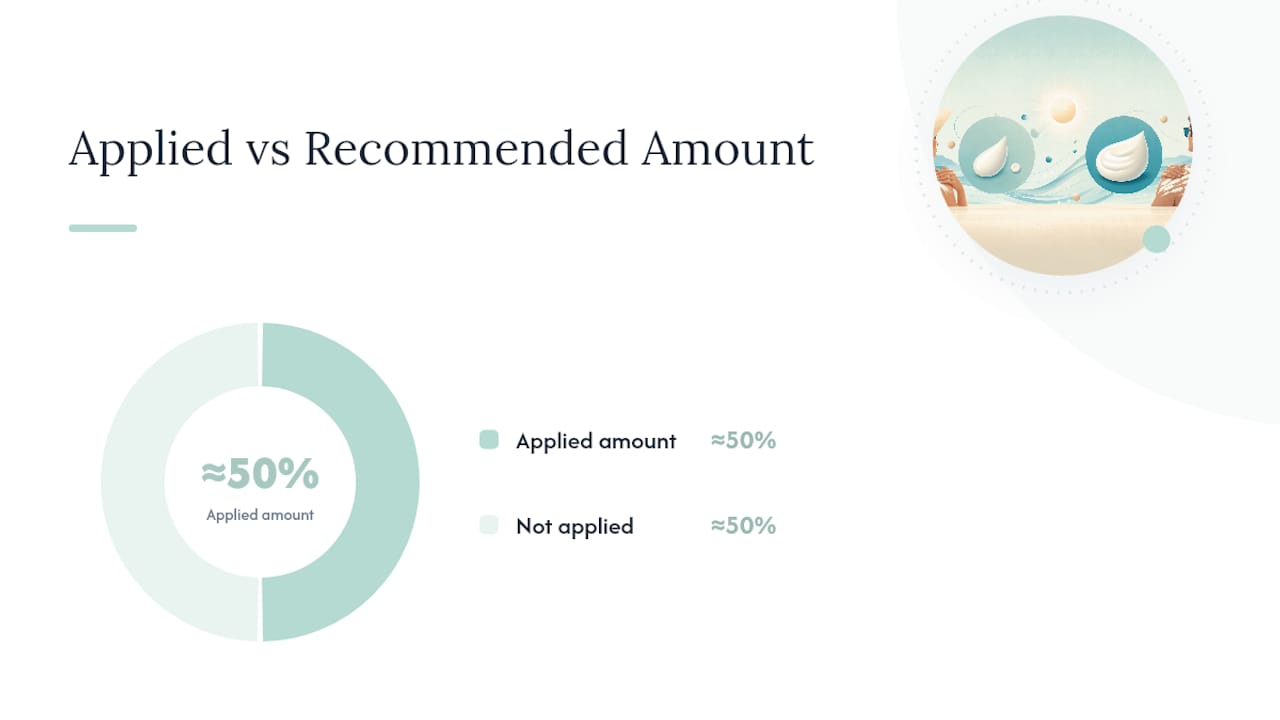
The FDA’s 2 mg/cm² lab standard is the benchmark for every SPF rating. Most people apply roughly half that amount, which can cut effective SPF dramatically. An SPF 50 applied at half the recommended amount may perform closer to SPF 17 in practice.
This is where higher SPF earns its keep. If you know you tend to apply lightly, or you are chasing kids around a pool, SPF 50 gives you more room for error. Higher-SPF products reduce sunburn incidence in real-world extended exposure precisely because they compensate for imperfect application.
How to apply sunscreen correctly:
- Apply sunscreen 15–30 minutes before going outside if using a chemical formula (mineral sunscreens can be applied immediately before).
- Use one ounce (about a shot glass) for the full body; use a nickel-sized amount for the face.
- Cover commonly missed areas: ears, back of the neck, tops of feet, and the back of hands.
- Reapply every two hours, or immediately after swimming, heavy sweating, or toweling off, per Cleveland Clinic guidance.
- Do not rely on SPF alone. Shade, UPF clothing, hats, and sunglasses all reduce UV exposure.
Pro Tip: If you are heading to a beach, a ski slope, or any activity where reapplication is inconvenient, start with SPF 50. The extra margin covers the gaps.
When should you choose SPF 50?
For most people on most days, SPF 30 is fine. But several situations genuinely call for SPF 50 or higher.
Choose SPF 50 when:
- You will be outdoors for more than two hours, especially during peak UV hours (10 AM to 4 PM).
- You are near reflective surfaces: water, snow, and sand all amplify UV exposure.
- You are at high altitude or traveling to tropical or near-equator destinations.
- You take photosensitizing medications (certain antibiotics, retinoids, diuretics, and others that increase UV sensitivity).
- You have a personal or family history of skin cancer.
- You manage melasma, hyperpigmentation, or other pigmentary conditions. For darker skin tones, SPF and pigmentary protection are both relevant considerations.
- You are immunocompromised or have had recent skin procedures (chemical peels, laser treatments).
- You are applying sunscreen to infants or young children in any outdoor setting.
Experts recommend SPF 50 specifically for people with a history of skin cancer, those on photosensitizing medications, or those managing pigmentary conditions like melasma.
Pro Tip: Tinted mineral sunscreens at SPF 50 offer an added layer of visible-light protection, which can be helpful for people managing melasma or post-inflammatory hyperpigmentation. An anti-aging skincare guide can help you pair SPF with other protective steps.
How to choose a sunscreen beyond the SPF number
SPF is one variable. These are the others that determine whether a sunscreen actually protects you.
Label checklist before you buy:
- SPF 30 or higher (SPF 50+ for extended outdoor use)
- Broad spectrum (required for UVA coverage)
- Water resistant when swimming or sweating (labeled 40 or 80 minutes)
- Not expired (check the date)
Mineral vs. chemical formulas:
Mineral and chemical sunscreens work differently and suit different skin types. Mineral formulas (zinc oxide, titanium dioxide) sit on top of skin and reflect UV; they tend to be better for sensitive skin and are reef-safe. Chemical formulas absorb UV and convert it to heat; they are often lighter and easier to blend, which can encourage more consistent use.
Formulation trade-offs:
| Dimension | SPF 30 | SPF 50 |
|---|---|---|
| UVB blocked (nominal) | ~97% | ~98% |
| UVA coverage | Broad spectrum if labeled | Broad spectrum if labeled |
| Real-world effectiveness | Strong with correct application | Higher margin for under-application |
| Best use case | Daily, incidental exposure | Prolonged outdoor, high-risk situations |
| Water resistance | Available in both | Available in both |
| Cosmetic tolerability | Often lighter; easier daily wear | Slightly thicker formulas common; tinted options available |
A heavier formula you apply thoroughly beats a lighter one you skip. Tolerability drives consistency, and consistent use is what dermatologists emphasize most. For face-specific use, a sheer or tinted mineral serum at SPF 50 often solves the tolerability problem without sacrificing protection. Learn more about integrating SPF into your daily makeup routine.
What do dermatologists and major health organizations recommend?
The guidance from major dermatology and public health bodies is consistent.
Organizational positions at a glance:
- AAD: SPF 30 minimum for daily use, broad spectrum, reapply every two hours.
- Skin Cancer Foundation: SPF 30+ for daily/incidental exposure; SPF 50+ for extended outdoor activities.
- FDA: SPF values reflect lab conditions at 2 mg/cm²; broad-spectrum labeling requires passing a separate UVA test.
- Cleveland Clinic: Reapply every two hours and immediately after swimming, sweating, or toweling off.
Dermatologists consistently note that behavior, not the SPF number, is the primary driver of real-world protection. The sunscreen you use correctly and reapply on schedule will protect you better than a higher-SPF product you apply once and forget.
A practical checklist for applying sunscreen correctly
Step-by-step routine:
- Choose SPF 30+ for daily use; SPF 50+ for prolonged outdoor or high-risk situations.
- Apply to dry skin 15–30 minutes before sun exposure (chemical formulas); mineral formulas can go on right before.
- Use one ounce for the body (a full shot glass). Use a nickel-sized amount for the face.
- Do not miss: ears, back of neck, tops of feet, back of hands, and the scalp if not covered.
- Reapply every two hours. After swimming, sweating heavily, or toweling off, reapply immediately regardless of time elapsed.
- For children, use SPF 50 and reapply frequently. Infants under six months should be kept out of direct sun.
Dos and don’ts:
- Do layer sunscreen under makeup, not over it. Check common sunscreen layering mistakes to avoid reducing effectiveness.
- Do combine sunscreen with shade, UPF-rated clothing, wide-brim hats, and UV-blocking sunglasses.
- Don’t assume water-resistant means waterproof. Reapply after any water exposure.
- Don’t rely on SPF in foundation or moisturizer alone. The amount applied is almost always too low to reach the labeled SPF.
An editorial note on the SPF 30 vs 50 decision
The SPF 30 vs 50 debate gets more attention than it probably deserves. The real gap in sun protection for most people is not between SPF 30 and SPF 50. It is between applying sunscreen and not applying it, or between reapplying and skipping the second coat.
That said, the case for SPF 50 as a default is not unreasonable. Most people under-apply, and the extra margin costs little in a well-formulated product. If you are outdoors for hours, near water, or managing a skin condition, SPF 50 is the straightforward choice. For a quick commute or a day mostly indoors, SPF 30 does the job.
The practical rule: keep an SPF 30 in your daily bag and an SPF 50 for beach days, hikes, and anything that keeps you outside past noon. Reapplication matters more than which one you grab.
Miamibeachbum’s SPF 50 options for when extra protection counts
When SPF 50 is the right call, Miamibeachbum has two reef-safe mineral options built for real outdoor use.
Blocked SPF50 is a mineral sunscreen spray designed for broad body coverage. It is reef-safe, water-resistant, and built for days when you need full-body protection without the mess of a thick lotion. Ideal for beach days, outdoor sports, and any activity where you need to cover a lot of skin quickly.
Save Face SPF 50 Sheer Mineral Facial Serum is the face-specific option: a lightweight, sheer mineral formula that layers cleanly under makeup and suits daily use. It is a strong choice for anyone managing pigmentary concerns or simply wanting higher facial protection without a heavy finish.
Both are available directly at Miamibeachbum. If you want to try multiple sun care and body care products together, the Bodycare Discovery Set is a practical starting point.
Sources
- Do you need SPF 30, 50 or 100? Dermatologists answer your burning sunscreen questions | PBS News
- Sun Protection Factor (SPF) | FDA
- How often to reapply sunscreen | Cleveland Clinic
This article provides general information about sunscreen and sun protection. It is not a substitute for professional medical advice. Consult a dermatologist for guidance specific to your skin type, medical history, or medications.