


Octocrylene is safe in sunscreen at the concentrations regulators allow, generally up to 10%. The Scientific Committee on Consumer Safety (SCCS) and the FDA both back its use at that ceiling. A 2025 toxicology review found a margin of safety above 100 at typical use levels. The real caveats are narrower than the headlines suggest: rare photoallergic reactions, some environmental persistence, and spray formulations that deserve extra scrutiny. Here’s the full picture, plus what to look for on a label.
TL;DR:
- Octocrylene is regulated to a maximum of 10% in the EU, with spray formulations requiring extra caution due to inhalation risks.
- Toxicology reviews show a wide safety margin with a margin of safety above 100 at typical use levels, though allergic reactions remain rare.
- Environmental concerns focus on octocrylene’s persistence and degradation into benzophenone, which can impact marine ecosystems if sunscreen is stored improperly.
- The ingredient stabilizes UVA filters like avobenzone and improves water resistance, making it a popular choice for formulations needing both UV protection and stability.
- People with ketoprofen allergies or sensitive skin should consider mineral sunscreens, and proper storage and label checking are key for safe, effective use.
Table of Contents
- Regulatory Status: What “Up to 10%” Actually Means
- Human Safety: What Toxicology and Clinical Data Show
- Environmental Impact: Coral, Persistence, and What You Can Control
- Why Formulators Reach for Octocrylene in the First Place
- How to Choose a Sunscreen If Octocrylene Concerns You
- Behind This Guide: Miami Beach Bum’s Approach to Sun Care
- What Recent Research Says About Cancer and Hormone Concerns
- Octocrylene vs. Avobenzone, Zinc Oxide, and Other UV Filters
- A Straightforward Take on Sunscreen Trade-Offs
- Reef-Conscious Sun Care That Doesn’t Cut Corners on Protection
- Sources
Regulatory Status: What “Up to 10%” Actually Means
That’s the maximum concentration the SCCS opinion on octocrylene permits in cosmetic products sold in the European Union, and it’s the ceiling most global formulators treat as the practical standard. The committee reviewed dermal absorption data, reproductive toxicity studies, and photostability research before landing on that figure. Products that stay under it are working within a limit that’s been through a formal safety assessment, not a marketing decision.
The SCCS opinion carries one specific caveat worth knowing: it flags propellant spray formulations separately. Inhalation exposure changes the risk math compared to a lotion rubbed onto skin, so aerosol sunscreens containing octocrylene near the 10% mark get extra scrutiny in that opinion. If you use spray sunscreen regularly, this is the one nuance actually worth paying attention to, more than any headline about “chemicals in sunscreen.”
In the United States, octocrylene has a longer regulatory history. The FDA historically classified it as a Category I UV filter, meaning it was already recognized as safe and effective under older monograph rules. That classification predates the broader OTC sunscreen rulemaking that began in 2019, which reopened data requirements for several sunscreen actives, octocrylene included, as part of a modernization effort. That review is about updating the evidence base to current standards, not a signal that the ingredient failed a safety test. The FDA’s own guidance on the rulemaking explains the distinction in plain terms if you want the primary source.
What does this mean at the shelf level? A few practical points:
- Check the “Active Ingredients” panel, not the marketing copy on the front of the bottle. Octocrylene will be listed by name with its percentage.
- U.S. products cap total active ingredient combinations differently than EU products, so the same brand can have slightly different formulas depending on where it’s sold.
- A product sitting at or near 10% octocrylene isn’t automatically riskier than one at 2%. Both fall inside the range regulators have assessed.
- Spray formats are worth a second look if you’re specifically concerned about inhalation, per the SCCS caveat above.
Concentration limits get enforced through the same regulatory apparatus that governs drug and cosmetic manufacturing generally, meaning companies self-certify compliance and face recalls or warning letters if products test outside approved ranges, as seen in cosmetic inventory sources like Cosmetic Pallets at Mega Pallets Liquidation. It’s not a perfect system, but it’s the same one that governs the sunscreen aisle broadly, chemical and mineral filters alike.
Human Safety: What Toxicology and Clinical Data Show
The honest answer is that octocrylene causes allergic reactions in a small minority of users, and serious systemic harm has not been demonstrated at typical use levels. Those two facts sit next to each other without contradiction, and understanding both is the difference between informed caution and unnecessary panic.
A margin of safety above 100 means a wide buffer. A 2025 comprehensive toxicology review calculated margins of safety exceeding 100 for octocrylene at concentrations up to 10%, using conservative exposure assumptions. In toxicology, a margin of safety compares the dose at which no adverse effect was observed in animal studies (the NOAEL) against estimated real-world human exposure. A margin over 100 is generally treated as a strong safety buffer, and it’s the same kind of calculation regulators run on food additives and medications, not a bar unique to sunscreen.
On the allergy side, contact and photoallergic dermatitis to octocrylene do occur, documented in dermatology case reports and clinical literature, but they remain uncommon relative to how widely the ingredient is used across the sunscreen market. One detail dermatologists flag specifically: people with a known allergy to ketoprofen, an anti-inflammatory drug, carry a higher risk of cross-reacting to octocrylene because the two molecules share structural similarities. If you’ve ever had a reaction to ketoprofen gel or tablets, that’s worth mentioning to a dermatologist before trying a new sunscreen with octocrylene.
Absorption is the other piece people worry about, and the data here is more reassuring than the online chatter suggests. In vitro human skin studies reviewed on NCBI found low percutaneous absorption of octocrylene, meaning most of what’s applied stays on the skin surface rather than passing through it. Biomonitoring studies do detect octocrylene metabolites in blood or urine at low levels in people who use sunscreen regularly. Detectable is not the same as harmful. Trace levels show up because modern lab equipment can measure parts per billion, not because the body is accumulating a toxic dose.
A few points worth holding onto:
- Photoallergic reactions are rare but real, and ketoprofen allergy history raises individual risk.
- Percutaneous absorption is measured as low in controlled skin studies, not zero, but low.
- Biomonitoring detects metabolites; detection alone doesn’t establish a health effect.
- Margin-of-safety calculations above 100 come from peer-reviewed toxicology data, not manufacturer claims.
Where things get genuinely murkier is animal endocrine research. The SCCS opinion itself notes some in vivo signals suggesting endocrine activity, and it explicitly calls for further study rather than closing the book. Regulatory toxicologists tend to caution that early endocrine markers in animal models don’t automatically translate into human-relevant hazard at the doses people actually encounter through sunscreen use. That’s a fair distinction, but it’s also why this remains an area of active research rather than settled science. If you have a personal or family history that makes hormone-related caution a priority, that’s a reasonable factor in choosing mineral filters instead, and nobody should tell you otherwise.
Environmental Impact: Coral, Persistence, and What You Can Control
Octocrylene’s environmental profile is where the science is less settled than its human safety data, and it’s worth treating that distinction honestly rather than glossing over it. Research reviewed in studies on environmental impacts of UV filters has raised concerns about octocrylene’s persistence in marine environments and potential effects on coral and other aquatic organisms. Unlike the human toxicology data, which has converged around a fairly confident safety margin, the ecotoxicology picture is still developing, with researchers flagging both the parent compound and its breakdown products as areas needing more field data rather than just laboratory models.
One specific chemistry detail matters here: octocrylene can degrade into benzophenone over time, particularly in products that have been exposed to heat or UV light for extended periods, like a bottle left in a hot car or a beach bag all summer. Benzophenone carries its own regulatory scrutiny separate from octocrylene itself, which is one more reason product freshness matters more than most people assume.
Practical steps you can actually take:
- Store sunscreen away from direct heat. A cooler bag at the beach beats a sun-baked car console.
- Replace sunscreen once it’s past its expiration date, since degradation products accumulate over time and defeat the purpose of the SPF number on the bottle.
- Look for reef-conscious formulations and third-party certifications when persistence and marine impact are priorities for you.
- Rinse off in a shower rather than letting sunscreen wash directly into open water where possible, since runoff is a meaningful exposure pathway for reef ecosystems.
Pro Tip: Keep sunscreen in your bag’s shaded interior pocket, not the outer mesh pocket that bakes in direct sun. Heat exposure is the single easiest variable to control, and it directly affects how fast active ingredients degrade.
Miamibeachbum builds its reef-conscious approach around exactly this tension: wanting broad-spectrum protection without contributing unnecessarily to marine impact. That’s a formulation philosophy, not a claim that every chemical filter is dangerous to reefs. It’s a preference for minimizing what goes into the water when a mineral-forward option performs comparably.
Why Formulators Reach for Octocrylene in the First Place
Octocrylene earns its spot in sunscreen formulas by doing two jobs at once: absorbing UVB rays directly and stabilizing avobenzone, the workhorse UVA filter that degrades quickly on its own when exposed to sunlight. Avobenzone without a stabilizer can lose a meaningful portion of its effectiveness within an hour of sun exposure. Pairing it with octocrylene slows that breakdown considerably, which is why the two show up together on so many ingredient lists. Chemical property data shows octocrylene’s molecular structure gives it strong photostability of its own, which is part of what makes it useful as a stabilizing partner rather than just another filter competing for the same job.
Beyond broad-spectrum coverage, octocrylene contributes a few things formulators value:
- Improved water resistance, since it helps the overall formula adhere better to skin during swimming or sweating.
- A lighter, less greasy skin feel compared to some alternative stabilizers, which matters for whether people actually reapply.
- Better photostability across the whole formula, not just for avobenzone specifically.
Remove octocrylene from a formula and something has to fill the gap. Research on UV-filter combinations notes that avobenzone loses UVA performance without an adequate stabilizer, so reformulating without octocrylene usually means swapping in a different stabilizer, increasing mineral filter load, or accepting a heavier, chalkier texture. None of those trade-offs are dealbreakers, but they’re real, and “octocrylene-free” doesn’t automatically mean “simpler” or “safer” if the replacement hasn’t been tested as thoroughly. If you want to compare how mineral and chemical systems each handle these trade-offs, Miamibeachbum’s breakdown of chemical versus mineral sunscreen walks through the practical differences.
How to Choose a Sunscreen If Octocrylene Concerns You
You don’t need a chemistry degree to shop smart here. A short, deliberate process gets you most of the way there.
- Read the active ingredient panel first. Octocrylene will be listed by name with its percentage. If you want to avoid it entirely, this is the only reliable way to know, since front-of-bottle marketing rarely tells you.
- Compare broad-spectrum claims against actual SPF and filter combinations. A high SPF number with a thin filter lineup can underperform a moderate SPF with well-paired UVA and UVB filters.
- Choose mineral filters if you want to avoid octocrylene specifically. Zinc oxide and titanium dioxide provide broad-spectrum protection without relying on octocrylene as a stabilizer, though they can leave more of a visible cast on darker skin tones depending on the formula’s micronization.
- Patch test if you have a history of photoallergy or ketoprofen sensitivity. Apply a small amount to your inner forearm, wait 48 hours, and check for redness or irritation before applying broadly to your face or body.
- See a dermatologist if you get a reaction after sun exposure specifically, not just from applying the product, since that pattern points toward photoallergy rather than standard contact irritation.
- Store sunscreen properly in a cool, shaded spot, and replace it once it passes its expiration date to avoid degradation byproducts like benzophenone.
Pro Tip: If you’re switching from a chemical to a mineral formula for the first time, expect a short adjustment period. Mineral sunscreens sit differently on skin, and it usually takes two or three applications before you find the right amount to avoid a white cast without under-applying.
For daily wear under makeup, Miamibeachbum’s guide on SPF in your daily routine covers how to layer sunscreen without it pilling or breaking down your foundation.
Behind This Guide: Miami Beach Bum’s Approach to Sun Care
This article draws on regulatory opinions, peer-reviewed toxicology reviews, and clinical dermatology literature rather than secondhand summaries, and it was written by Ayssa for Miamibeachbum’s editorial team. A few things worth knowing about how the brand approaches this topic:
- Miamibeachbum prioritizes reef-conscious and mineral-forward formulations where performance allows, without pretending every chemical filter is inherently unsafe.
- The brand’s guide on why sunscreen gets a bad reputation tackles the broader misinformation cycle around sunscreen ingredients generally.
- Product formulation decisions are made with both skin sensitivity and marine impact in mind, reflected in options like the Save Face SPF 50 Sheer Mineral Facial Serum.
The goal isn’t to scare you away from sunscreen. It’s to help you choose one you’ll actually reapply.
What Recent Research Says About Cancer and Hormone Concerns
The claims that circulate most aggressively online, that octocrylene causes cancer or significantly disrupts hormones at typical use levels, don’t hold up against the current body of peer-reviewed evidence. The 2025 toxicology review calculating margins of safety above 100 specifically assessed carcinogenicity endpoints alongside general toxicity, and found no signal indicating human cancer risk at concentrations up to 10%.
The endocrine question is more nuanced, and it deserves an honest answer rather than a dismissive one. The SCCS opinion itself acknowledges some in vivo indications of endocrine activity in animal studies, which is exactly why the committee called for further research rather than issuing a blanket dismissal. Regulatory toxicologists generally draw a distinction between an early biological marker showing up in an animal model and that marker translating into an actual health effect in humans at realistic exposure doses. Those are two very different claims, and conflating them is where a lot of the online alarm comes from.
Where does that leave you? The scientific consensus, as reflected in the major regulatory reviews, is that octocrylene at approved concentrations does not present a demonstrated carcinogenic or endocrine-disrupting risk to humans under normal use. That consensus comes with an asterisk: endocrine research is ongoing, and responsible bodies like the SCCS are keeping the question open rather than closing it prematurely. That’s how good regulatory science is supposed to work.
Octocrylene vs. Avobenzone, Zinc Oxide, and Other UV Filters
No single UV filter wins on every axis, and understanding the trade-offs helps you pick based on what actually matters for your skin and routine rather than which ingredient made headlines this week.
Octocrylene absorbs UVB rays and stabilizes UVA filters like avobenzone, giving it a dual role that’s hard for a single mineral filter to replicate on its own. Avobenzone alone provides strong UVA coverage but degrades quickly without a stabilizing partner, which is precisely the gap octocrylene fills. Zinc oxide and titanium dioxide, the two mineral filters, sit on top of skin and physically scatter or reflect UV radiation rather than absorbing it chemically. They carry a longer track record of minimal systemic absorption and are generally the first recommendation for sensitive or reactive skin, infants, and anyone actively trying to minimize chemical filter exposure for personal reasons.
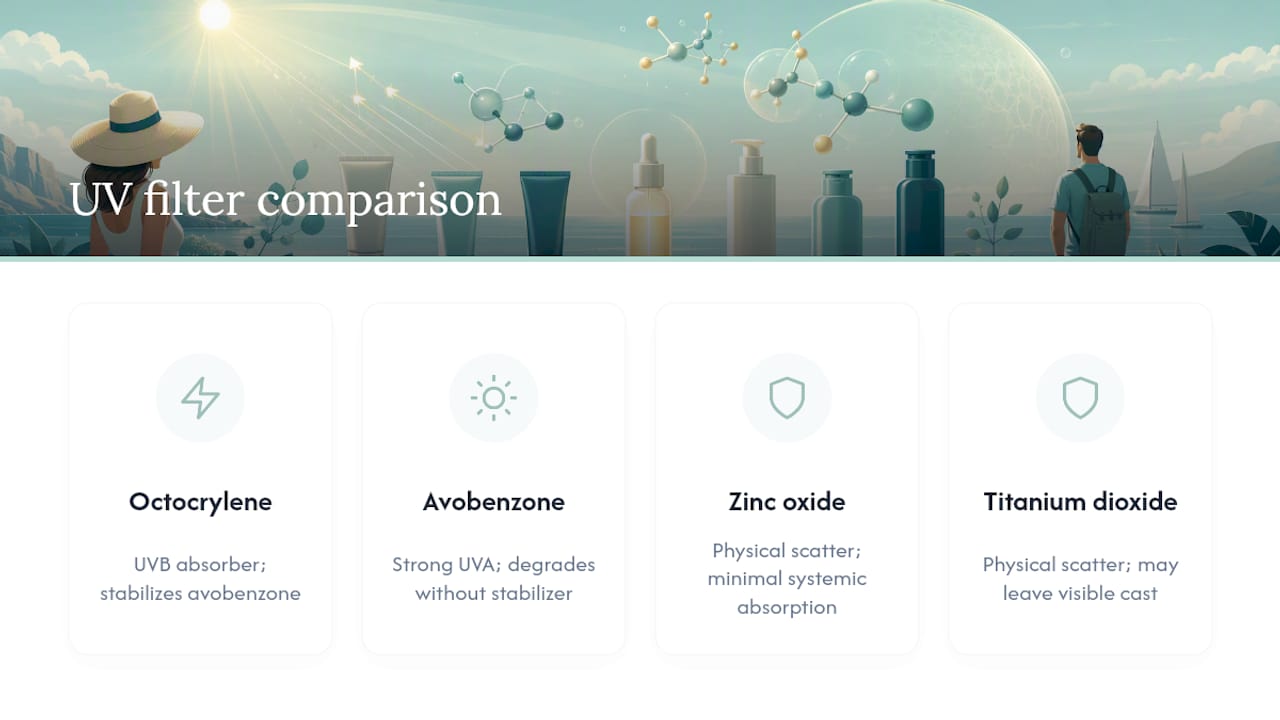
On efficacy, well-formulated chemical filter combinations, octocrylene included, often deliver a lighter, more cosmetically elegant finish and can achieve high SPF ratings at thinner application layers. Mineral formulas have closed much of that gap in recent years through better micronization, though some users still notice a visible cast, particularly on deeper skin tones.
On safety, both categories have solid regulatory backing at their approved concentrations. The meaningful difference is more about personal risk factors, ketoprofen allergy history, environmental priorities, and skin sensitivity, than a clear “one is safer” verdict across the board.
A Straightforward Take on Sunscreen Trade-Offs
Consistent sunscreen use is the single biggest lever most people can pull for skin health, and that’s true whether the bottle contains octocrylene or zinc oxide. Skipping sunscreen because of a single ingredient concern is, in nearly every case, a worse outcome than using an octocrylene-based formula correctly and reapplying it.
That said, ingredient trade-offs are real and worth respecting. If you have a ketoprofen allergy, sensitive skin, or a strong environmental preference, choosing mineral or octocrylene-free products is a reasonable, informed decision. What matters most is picking a formula you’ll actually wear daily and reapply outdoors. Miamibeachbum’s own product lineup reflects that philosophy: give people effective, reef-conscious options and let personal skin needs guide the choice.
— Ayssa
Reef-Conscious Sun Care That Doesn’t Cut Corners on Protection
If you’ve read this far weighing formulation trade-offs, Miamibeachbum built its sun care line around exactly that balance. Blocked SPF50 offers reef-conscious, mineral-forward broad-spectrum protection for daily body wear, while the Save Face SPF 50 Sheer Mineral Facial Serum gives your face a lighter, sheer finish without the greasy cast older mineral formulas were known for.
Not sure which formula fits your skin yet? The Bodycare Discovery Set lets you try sun care alongside the brand’s Bum + Body Cream and other essentials in one low-commitment order, so you can figure out what your skin actually likes before committing to full sizes. If razor burn or body breakouts are part of your summer routine too, that cream is worth pairing with your sunscreen shop. Head to the Bum + Body collection to build a routine that matches both your skin sensitivity and your environmental priorities, starting with whichever SPF fits how you actually spend your time outdoors.
This article is general information, not a substitute for advice from a qualified doctor. Consult a qualified healthcare professional about your own circumstances before acting on anything here.
Sources
- Sunscreen drug products for over-the-counter human use (Federal Register)
- NCBI review on sunscreen absorption and systemic exposure