


Mineral nanoparticles like zinc oxide and titanium dioxide are effective UV filters, and current evidence shows topical use as directed carries low systemic risk. The real caveats sit elsewhere: inhaling sprays or powders, unresolved environmental questions around reef ecosystems, and thin data on decades-long exposure. The sections below walk through the skin-penetration research, inhalation guidance, and how to pick a formulation that fits your skin and your conscience.
TL;DR:
- Inhalation of spray or powder sunscreens poses a much higher risk than skin absorption, especially for children and during windy outdoor applications.
- Coatings on nanoparticles are essential for reducing chemical reactivity and environmental impact, but uncoated TiO2 may generate reactive oxygen species under UV exposure.
- Laboratory studies show mineral nanoparticles do not typically penetrate beyond the skin’s surface when used as directed, with systemic absorption remaining unlikely.
- High-concentration ocean water and reef environments dilute and disperse sunscreen residues, making laboratory findings on coral bleaching less applicable to typical beach scenarios.
- Choosing between nano and non-nano sunscreens depends on cosmetic preferences and environmental concerns, with both providing effective protection when applied properly.
Table of Contents
- What Nanoparticles in Sunscreen Actually Do
- Skin Penetration and Systemic Absorption: What the Research Says
- Sprays, Powders, and Why Inhalation Changes the Risk Calculation
- Coral Reefs and Aquatic Life: Separating Lab Results From Beach Reality
- Reading Sunscreen Labels: Nano, Non-Nano, and What the Terms Mean
- Choosing and Using a Nanoparticle Sunscreen: A Practical Checklist
- Where Miamibeachbum Fits Into the Nanoparticle Conversation
- The Real Trade-Off Nobody States Plainly Enough
- Meet Blocked SPF50: A Mineral Option Built for Real Days Outside
- Sources
- FAQ
What Nanoparticles in Sunscreen Actually Do
Nanoparticles, by definition, measure under 100 nanometers, smaller than a red blood cell by a wide margin. In sunscreen, that means zinc oxide (ZnO) and titanium dioxide (TiO2) ground down small enough to scatter and absorb UV light without leaving the thick white residue older mineral formulas were known for.
Shrinking the particle size changes more than looks. It changes how the mineral interacts with light and skin, which is why formulators treat particle size as a design choice, not just a manufacturing shortcut.
- Reduced white cast: Smaller particles scatter visible light less, letting the formula sit closer to invisible on skin.
- Coatings: Silica, dimethicone, and triethoxycaprylylsilane are commonly applied to particle surfaces to limit reactivity and improve texture.
- Crystal form matters: TiO2 comes in anatase and rutile forms, and anatase generates more reactive oxygen species under UV exposure, which is why most sunscreen formulas favor rutile or coated anatase.
Those coatings aren’t cosmetic filler. They’re the primary lever formulators use to manage a real chemical risk while keeping the sunscreen sheer.
Skin Penetration and Systemic Absorption: What the Research Says
The Therapeutic Goods Administration’s literature review is one of the most cited safety assessments on this topic, and its conclusion is consistent: the majority of in vitro and in vivo studies show ZnO and TiO2 nanoparticles do not travel past the stratum corneum, the dead outer layer of skin. Systemic absorption, the review found, is unlikely when sunscreens are used as directed.
The bigger picture: A separate review in Current Dermatology Reports found that ZnO and TiO2 carry the most reassuring human-safety data of any common sunscreen filter, ahead of several organic chemical filters still on the market.
That doesn’t mean the research record is perfectly clean. A small number of human studies have detected trace amounts of TiO2 in viable epidermal layers or plasma after repeated, controlled application. Those findings come from limited sample sizes and specific exposure conditions, and they haven’t been replicated widely enough to overturn the broader body of evidence. Isolated positives in a small dataset are worth noting, not worth panicking over.
The mechanism behind the lingering concern is photocatalysis. When UV light hits uncoated or poorly coated TiO2, it can generate reactive oxygen species, molecules capable of damaging cells on contact. Coatings reduce this effect substantially, though research indicates they may not eliminate it entirely at the particle surface.
Here’s the trade-off that matters most for your daily decision:
- Skin cancer and photoaging from unprotected UV exposure are well-documented, common, and preventable.
- Nanoparticle-related harm, where it exists at all, appears at low probability and mostly in specific exposure scenarios, not everyday topical use.
Given that comparison, skipping sunscreen over nanoparticle worry is the far riskier move.
Sprays, Powders, and Why Inhalation Changes the Risk Calculation
Swallowing or absorbing nanoparticles through skin is one risk profile. Breathing them into your lungs is a different one entirely, and regulators treat it that way. Particles small enough to become airborne in a spray mist can deposit deep in lung tissue, where clearance mechanisms work far slower than on skin. The European Commission’s Scientific Committee on Consumer Safety has specifically flagged inhalation as the exposure route of greatest concern for nano-form TiO2, advising against spray use near children in particular.
Here’s how to apply that guidance in practice:
- Skip sprays on the face. Spray directly onto hands first, then rub in, or switch to a lotion for facial application entirely.
- Use lotions for kids. Children’s smaller airways and higher breathing rates make inhalation exposure proportionally larger; for practical guidance, see UV‑Schutz für Babys beim Schwimmen: der Praxisplan.
- Avoid powdered mineral products with nanoparticles altogether, since loose powder is the easiest form to inhale accidentally.
Pro Tip: If you’re applying sunscreen at the beach on a windy day, step behind a towel or turn away from the wind before spraying, even when applying to your own body. Drift happens more than people assume.
Occupational exposure, factory workers handling raw nanoparticle powder daily, involves concentrations far above anything a consumer encounters at the beach. Your risk profile as a shopper is nowhere near that of someone manufacturing the raw material.
Coral Reefs and Aquatic Life: Separating Lab Results From Beach Reality
Laboratory studies have shown that ZnO nanoparticles can trigger coral bleaching, but only under tightly controlled, high-concentration conditions that don’t map cleanly onto a typical beach day. Real ocean water dilutes, disperses, and interacts with sunscreen residue in ways a lab tank doesn’t replicate, so the extrapolation from petri dish to reef is far from settled.
Most reef-protection regulation to date has targeted oxybenzone and octinoxate, chemical filters with clearer bleaching evidence, rather than mineral nanoparticles. That said, monitoring of inorganic filters continues, and the science isn’t closed.
- Choose reef-conscious formulations when swimming near reef systems.
- Apply sunscreen 15 to 20 minutes before entering the water so it has time to bind to skin instead of washing off immediately.
- Rinse excess product off in a shower rather than letting it run into tide pools or reef-adjacent water.
Reading Sunscreen Labels: Nano, Non-Nano, and What the Terms Mean
Labeling rules differ sharply by region, and that inconsistency is a genuine source of consumer confusion. The European Union requires any ingredient in nanoparticle form to carry a “[nano]” tag directly on the ingredient list. The FDA has no equivalent formal nano threshold or labeling mandate for U.S. sunscreens, which means “nano zinc oxide sunscreen” products sold domestically won’t always announce themselves as such on the box.
Here’s what to look for instead:
- “Micronized” or “non-nano” on the label usually signals the brand is marketing particle size as a selling point, worth reading the fine print on either way.
- Zinc oxide and titanium dioxide listed as active ingredients confirms you’re using a mineral, not chemical, filter.
- “Coated” or specific coating ingredient names (dimethicone, silica) suggest formulation-level safety consideration.
The TGA and the EU’s Scientific Committee on Consumer Safety have both concluded penetration is minimal under normal use, while ongoing FDA rulemaking keeps its attention on broad-spectrum performance and SPF accuracy rather than nano-specific rules.
Choosing and Using a Nanoparticle Sunscreen: A Practical Checklist
Picking the right formula comes down to matching particle size, coating, and texture to how and where you’ll actually wear it.
- Confirm broad-spectrum coverage. SPF alone only measures UVB; broad-spectrum labeling confirms UVA protection too, which is the range linked more closely to photoaging.
- Choose lotion over spray for your face and for kids. This cuts inhalation exposure to close to zero.
- Consider a tinted mineral formula if white cast bothers you. Blending micro- and nano-sized zinc oxide with iron oxide tints can deliver broad-spectrum coverage without the ghostly finish, without needing to go nano-free.
- Apply enough. Most adults need an adequate amount to cover exposed skin, a dose people routinely underapply by half or more.
- Reapply regularly, especially after swimming or sweating, and immediately after swimming or heavy sweating, regardless of how “water resistant” the label claims.
Layering under makeup works best when you let sunscreen fully absorb for a minute or two before foundation. If you’re troubleshooting white cast specifically, tinted mineral formulas solve most of the problem without switching filter categories.
Pro Tip: Removing mineral sunscreen fully at night matters more than most people realize. An oil-based cleanser followed by your regular face wash breaks down the coating layer far more effectively than water alone.

Whether nano or non-nano suits you better depends on your priorities. Nano formulas win on cosmetic feel and blendability. Non-nano or micro-sized particles appeal to people prioritizing environmental caution or minimizing any inhalation exposure from adjacent spray use in their household. Neither choice is wrong; both are protective when applied consistently. For more on how filter type affects your skin and your routine, this comparison of chemical and mineral sunscreen breaks down the trade-offs in more depth.
Where Miamibeachbum Fits Into the Nanoparticle Conversation
This brand builds sun care products for people who spend time outside rather than just for display. The formulation questions in this article, white cast, coating choices, reef impact, aren’t academic for a brand built on beach days.
A few resources worth bookmarking if you’re still working through your options:
- Science-backed fixes for white cast with tinted mineral sunscreen
- How SPF interacts with your makeup routine day to day
- What reef-conscious beauty actually means when you’re shopping
This piece was reported and written by Ayssa, who covers sun care formulation and ingredient safety for Miamibeachbum.
The Real Trade-Off Nobody States Plainly Enough
UV exposure causes measurable, well-documented harm: skin cancer, premature aging, immune suppression. Nanoparticle risk, where it exists, is theoretical for most people and concentrated in specific scenarios like inhalation or heavy reef exposure. Skip sunscreen over nano-anxiety and you’ve traded a small, uncertain risk for a large, certain one.
If you have a toddler, a spray-allergic lung, or a reef trip planned, lean non-nano or lotion-only. Otherwise, follow the label, reapply on schedule, and let the evidence guide you instead of the headlines.
— Ayssa
Meet Blocked SPF50: A Mineral Option Built for Real Days Outside
Miamibeachbum makes daily mineral protection simple with Blocked SPF50, a lotion formula built to skip the ghostly cast that turns people off mineral sunscreen in the first place.
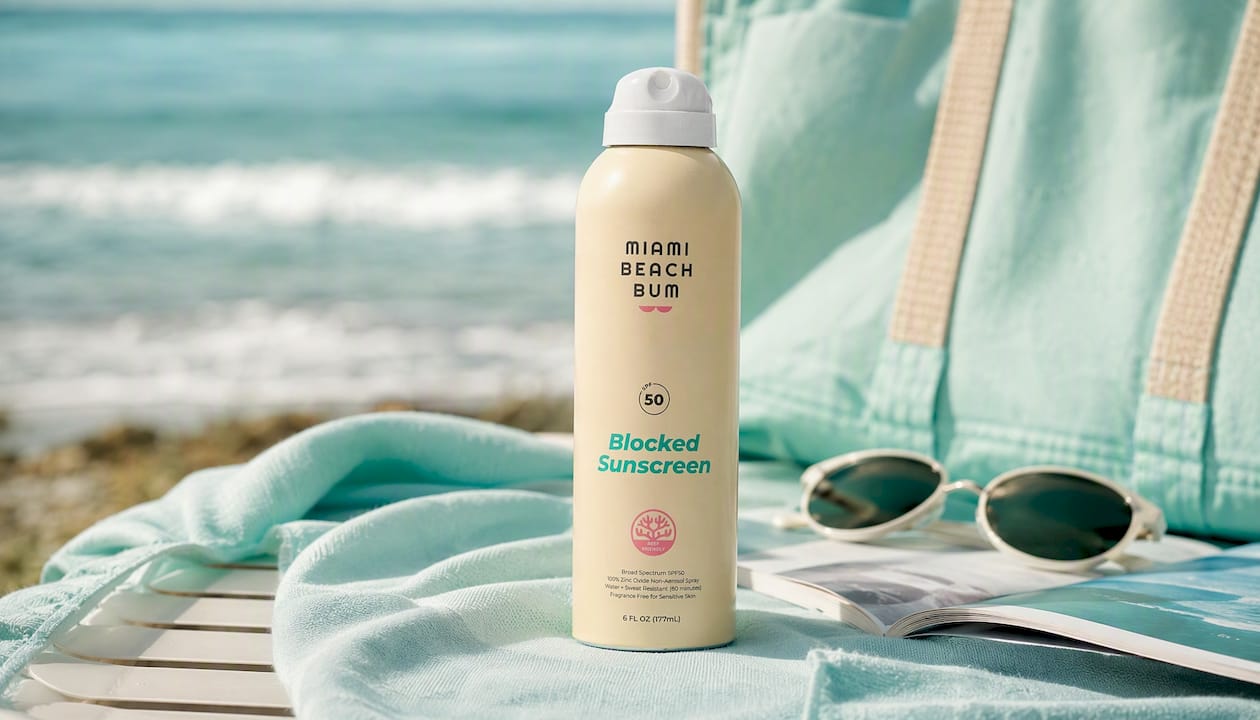
Blocked SPF50 is designed for daily body coverage and is suitable for those who prefer a lotion over a spray for easier application, and for shoppers seeking a mineral formula from a dedicated sun care brand. Apply a full ounce to exposed skin, reapply every two hours outdoors, and reapply immediately after swimming. If you’re specifically hunting for a spray format for large surface areas like a beach day with a group, a different formulation in your routine might suit that particular use case better. For daily wear, Blocked SPF50 is ready to add to your cart now.
Sources
- Titanium dioxide and zinc oxide nanoparticles in sunscreens: focus on their safety and effectiveness (PMC)
- Therapeutic Goods Administration (TGA) literature review on TiO2 and ZnO nanoparticles
- Environmental studies on sunscreen filters and coral impacts (NCBI PMC)
FAQ
What Are the Disadvantages of Nanoparticles in Sunscreen?
The main drawbacks are inhalation risk from sprays and powders, unresolved questions about environmental effects on coral, and a handful of studies detecting trace penetration that haven’t been widely replicated.
Is Sunscreen Full of Microplastics?
Some chemical sunscreen formulas contain synthetic polymers that raise microplastic concerns, but mineral sunscreens using zinc oxide or titanium dioxide are not plastic-based and fall outside that specific issue.
What Ingredient Should I Avoid in Sunscreen?
If you’re sensitive to chemical UV filters, octocrylene has raised safety questions worth reading about; mineral filters like zinc oxide remain the better-documented option for sensitive skin.
Is Nano or Non-Nano Sunscreen Better?
Neither is universally better. Nano formulas blend more easily and reduce white cast, while non-nano appeals to people prioritizing reef safety or avoiding inhalation exposure from sprays in the household.