


Sunscreen loses its protective power under UV exposure because the active filters inside it chemically change: they twist into different molecular shapes (isomerization), break apart (fragmentation), or lose the thin, even film that holds them on skin. That’s why a bottle labeled SPF 50 in the lab can perform closer to SPF 20 or 30 after two hours poolside. The photon energy that strikes a filter molecule gets absorbed and released in about one quadrillionth of a second (10^-15 s) when the formula is stable. When it isn’t, that energy triggers a chemical breakdown instead.
Here’s what to do about it right now:
- Choose a broad-spectrum, photostable formula with a critical wavelength of 370 nanometers or higher.
- Apply enough product. Most people use only a quarter to half the tested amount.
- Reapply every two hours, and immediately after swimming or heavy sweating.
- Pair sunscreen with UPF clothing, a hat, and shade during peak UV hours.
- Look for mineral actives (zinc oxide, titanium dioxide) or stabilized chemical filter blends if you’re prone to reapplying late.
Pro Tip: Rub a dime-sized amount into the back of your hand and check it after 15 minutes in direct sun. If it beads, streaks, or disappears into blotches, the film isn’t holding, and that product will underperform outdoors no matter what the label promises.
Key Takeaways
Sunscreen loses effectiveness under UV exposure primarily through photodegradation of its active filters and breakdown of its protective film, not simply through time passing.
| Point | Details |
|---|---|
| Photodegradation drives protection loss | UV exposure causes isomerization, fragmentation, or ROS formation in unstable filters like OMC. |
| Lab SPF overstates outdoor performance | About 40% of tested products failed optimal UVA protection outdoors, some losing 13% to 28% over two hours. |
| Mineral filters resist breakdown better | Zinc oxide and titanium dioxide absorb 85% to 95% of UV without the same chemical degradation pathway. |
| Application amount matters most | Most people apply 25% to 50% of the tested dose, cutting real-world SPF well below the label. |
| Choose photostable, mineral-based formulas | Miamibeachbum’s Blocked SPF50 and Save Face serum use mineral actives built for real outdoor stability. |
Table of Contents
- UVA, UVB, and What SPF Actually Measures
- What Happens Chemically When UV Hits a Sunscreen Filter
- Why Two Sunscreens With the Same Filters Perform Differently
- What Reduced UVA Protection Means for Your Skin
- How to Actually Get the Protection Your Sunscreen Promises
- Buying Checklist: What Makes a Sunscreen Photostable
- How SPF Testing Works, and What the Label Doesn’t Tell You
- Frequently Asked Questions
- Sources
UVA, UVB, and What SPF Actually Measures
UV radiation reaching your skin splits into two relevant bands: UVB (280 to 315 nanometers), which causes sunburn, and UVA (315 to 400 nanometers), which penetrates deeper and drives long-term skin aging. SPF numbers measure protection almost entirely against UVB. That’s a narrower job than most people assume.
Sunscreen filters fall into two broad families. Chemical (organic) filters, like avobenzone or octisalate, absorb UV photons and convert that energy through a molecular reaction. Mineral (inorganic) filters, zinc oxide and titanium dioxide, work differently. They absorb and scatter UV energy and convert most of it directly to heat, and because they lack the same reactive chemical structure as many organic filters, they tend to hold up better against photochemical breakdown.
“Broad spectrum” on a label means the product meets a minimum UVA protection standard alongside its UVB rating. The FDA and international standards require broad-spectrum products to hit at least 370 nanometers on that measure.
What Happens Chemically When UV Hits a Sunscreen Filter
Every sunscreen filter works the same basic way at the molecular level: it absorbs a UV photon, its electrons jump to an excited state, and then it has to shed that energy to return to normal. A genuinely photostable filter does this in about 10^-15 seconds, releasing the extra energy as heat with the molecule intact and ready to absorb another photon. That’s the goal. Not every filter gets there cleanly, according to research on UV filter photostability and human safety.
Unstable filters take destructive detours instead. Some undergo isomerization, physically rearranging their molecular shape from one configuration to another that absorbs UV far less efficiently. Other filters fragment outright, breaking into smaller molecules that no longer function as UV blockers, or react with neighboring compounds to generate reactive oxygen species (ROS), unstable molecules that can affect skin cells independently of the sun’s rays.
The gap between lab results and real-world performance is where this becomes practical, not just academic. Outdoor testing of 32 U.S.-market sunscreens found that about 40% failed to maintain optimal UVA protection once exposed to actual sunlight, with some products losing 13% to 28% of their UVA protection over just two hours.
| Metric | Reported figure |
|---|---|
| Energy dissipation time (stable filter) | ~10^-15 seconds |
| OMC absorptivity loss (unstable conditions) | a substantial range depending on conditions |
| Outdoor UVA protection loss (2 hours) | a notable decrease over two hours |
| Products failing optimal outdoor UVA protection | ~40% of 32 tested |
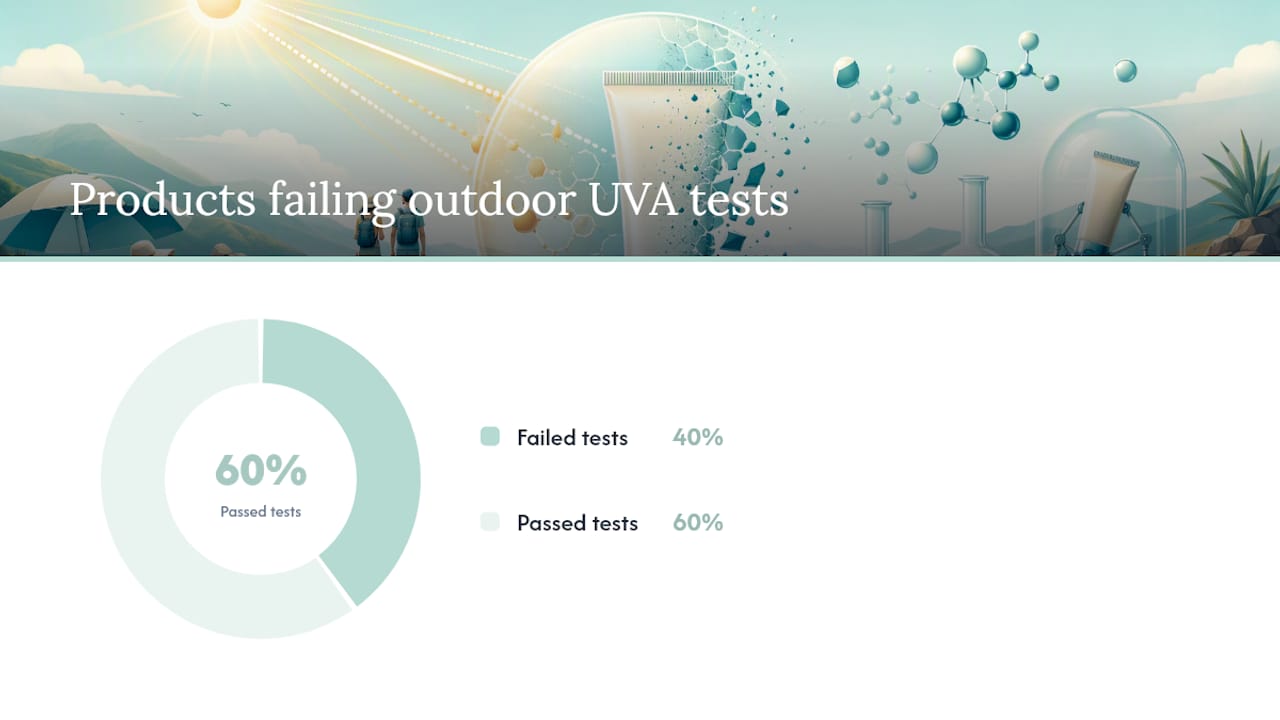
Nearly 4 in 10 sunscreens tested outdoors failed to deliver the UVA protection their lab results promised, a gap driven almost entirely by photodegradation and film breakdown once the product left the simulator and hit real sunlight.
Why Two Sunscreens With the Same Filters Perform Differently
Identical active ingredients don’t guarantee identical protection. Formulation, the polymers, solvents, and film-forming agents that hold filters evenly across skin, determines whether that protection survives contact with water, sweat, and heat. A poorly built film can crack, pool, or wash away long before the SPF rating suggests it should.
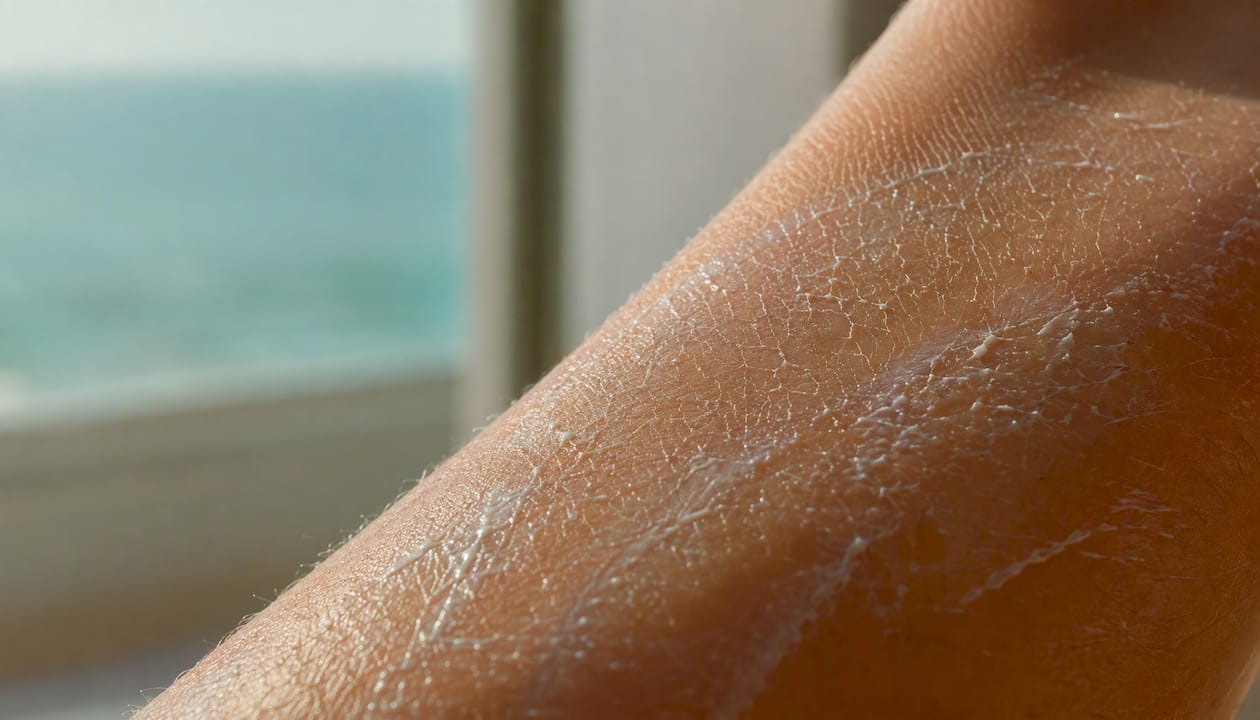
Formulators fight filter instability with photostabilizers, ingredients added specifically to interrupt destructive breakdown pathways. The classic example: avobenzone, an effective UVA filter, degrades rapidly on its own, so it’s commonly paired with octocrylene or similar stabilizers to slow that process. This lowers the rate of degradation. It doesn’t eliminate it, so combinations still perform differently depending on concentration and quality of formulation, based on studies of commercial sunscreen photostability.
Environmental conditions compound the problem:
- Heat accelerates chemical reaction rates, including degradation reactions.
- Humidity and sweat can thin the protective film or cause uneven redistribution.
- Reflective surfaces (water, sand, snow) increase total UV exposure hitting the skin.
- Thin application, the single most common real-world error, reduces the effective film thickness below what’s needed for the tested SPF to apply.
Mineral filters sidestep much of this. Because zinc oxide and titanium dioxide work through physical absorption and scattering rather than a reactive chemical pathway, they don’t isomerize or fragment the way organic filters can, which is part of why formulators often lean on them for stability-sensitive products.
What Reduced UVA Protection Means for Your Skin
Sunburn is the visible warning sign of UVB overexposure. UVA damage doesn’t announce itself the same way, but it accumulates. UVA rays penetrate deeper into skin, contributing to collagen breakdown, premature wrinkling, and DNA damage that SPF alone was never designed to measure, a limitation highlighted in reporting from Scientific American on how sunscreen actually works. When a sunscreen’s UVA protection drops mid-day due to photodegradation, that gap in coverage happens silently.
There’s a second layer of concern: degradation byproducts themselves. Photodegradation can generate reactive oxygen species and, in some cases, compounds linked to photoallergic reactions in sensitive users, according to research on filter photostability and safety. This doesn’t mean sunscreen causes harm. It means a breaking-down formula can add a small chemical burden on top of losing its protective function.
Reduced photostability raises the risk of:
- Sunburn, if UVB coverage fails alongside UVA
- Earlier visible photoaging, fine lines, sagging, loss of elasticity
- Uneven pigmentation and dark spots, especially in melanin-rich skin
- Irritation or photoallergic response from breakdown compounds in rare cases
Persistent UVA exposure from underperforming sunscreen is a documented driver of long-term skin damage that a sunburn-free day at the beach can mask entirely, an important reason to treat photostability as a real product criterion rather than a technical footnote. Readers managing pigmentation concerns can find more on how UVA exposure drives dark spot formation and how oxidative stress from UV exposure affects skin beyond visible burning.
How to Actually Get the Protection Your Sunscreen Promises
Reapply every two hours outdoors, and immediately after swimming, toweling off, or heavy sweating. Layer in physical protection: UPF-rated clothing, a wide-brim hat, and shade during peak UV hours (typically 10 a.m. to 4 p.m.) reduce your reliance on the sunscreen film holding perfectly all day, a strategy backed by combined sun-safety research.
- Apply sunscreen 15 minutes before sun exposure so the film sets.
- Use the full recommended amount, don’t stretch a bottle across too many uses.
- Set a two-hour reapplication timer, shorter if you’re swimming or sweating heavily.
- Check water-resistance duration on the label (40 or 80 minutes) and reapply immediately after that window.
- Layer UPF clothing or shade for extended outdoor time instead of relying on sunscreen alone.
Pro Tip: Test film stability before a big beach day: apply your sunscreen, wait 15 minutes, then press a tissue against your skin. If it transfers heavily or leaves visible streaking, that formula is shedding its protective layer faster than it should, and you’ll need to reapply more often than the label suggests. For guidance on stacking sunscreen with other skincare steps without compromising the film, see this breakdown of common layering mistakes.
Buying Checklist: What Makes a Sunscreen Photostable
Look for broad-spectrum labeling with a critical wavelength of 370 nanometers or higher, and prioritize formulas that either use stabilized chemical filter blends or lean on mineral actives.
- Watch for: octyl methoxycinnamate (OMC/octinoxate) as a sole UVA filter, it’s prone to significant absorbance loss without a stabilizer.
- Favor: zinc oxide and titanium dioxide, which resist chemical photodegradation better than most organic filters.
- Favor: avobenzone paired explicitly with a stabilizer like octocrylene rather than avobenzone alone.
- Check for: clear water-resistance duration (40 or 80 minutes) rather than vague “water resistant” claims with no timeframe.
- Be cautious of: marketing language implying all-day protection with a single application, no formula fully escapes reapplication needs.
For a deeper comparison of how these filter categories perform, this guide on chemical versus mineral sunscreen breaks down the tradeoffs by skin type and activity level.
How SPF Testing Works, and What the Label Doesn’t Tell You
SPF is measured indoors under a solar simulator, tracking how long it takes skin to redden (erythema) with sunscreen versus without it. That test targets UVB specifically. It says nothing directly about UVA-driven oxidative damage, and it doesn’t reproduce real-world stressors like sweat, humidity, or extended reapplication gaps, a limitation confirmed by in vivo SPF and UVA testing research.
UVA-PF (UVA protection factor) exists as a companion measure, but the United States has no single standardized numeric UVA rating on everyday product labels comparable to SPF. The critical wavelength requirement is the closest proxy consumers get.
- SPF number: measures UVB/sunburn protection under lab conditions, not total UV protection.
- “Broad spectrum”: confirms the product meets a minimum UVA threshold (370 nm critical wavelength), not that UVA protection matches the SPF number.
- Water resistance claims: state a tested duration, not permanent protection, always reapply after that window closes.
- Lab SPF vs. outdoor performance: expect some gap, driven by heat, sweat, and photodegradation the simulator doesn’t replicate.
Why Photostability Is the Detail Most Sun Care Guidance Skips
Most sun safety advice stops at “wear SPF 30 or higher” and treats the number as the whole story. It isn’t. A sunscreen’s SPF rating tells you what it can do in a controlled lab, not what it will actually do after 90 minutes of heat, sweat, and direct sunlight breaking down its filters in real time. That’s the piece Miamibeachbum builds around: reef-safe, marine-scientist-informed formulas designed with photostability and film integrity in mind, not just a headline SPF number.
Sunscreen is one layer, not the whole system. No single product, however well formulated, replaces that layered approach. Readers curious about the brand’s formulation philosophy and marine-science background can read more in Miamibeachbum’s origin story.
A Straightforward Product Note for Photostable Protection
If you’re shopping for a formula built around the photostability principles covered here, Miamibeachbum’s Blocked SPF50 is a reef-safe, broad-spectrum mineral sunscreen spray designed for real outdoor conditions, not just lab simulators. For facial use specifically, the Save Face SPF 50 Sheer Mineral Facial Serum pairs mineral UV protection with a lightweight, non-greasy finish that holds up under sweat and humidity.
Both formulas lean on mineral actives rather than photounstable organic filters alone, which lines up directly with the buying checklist above. If you’re building a full sun routine, the Bodycare Discovery Set is a low-commitment way to try the brand’s reef-safe lineup alongside your sunscreen. Check product pages for current formulations and pick the option that matches how much time you’ll actually spend outdoors.
Frequently Asked Questions
Why does sunscreen lose potency in the sun? Sunscreen loses potency because UV photons cause chemical changes in its active filters, isomerization, fragmentation, or reactions that reduce their ability to absorb UV, combined with physical loss of the protective film through sweat and friction.
How long does sunscreen protection actually last outdoors? Lab SPF ratings assume ideal, undisturbed application. Outdoors, protection can drop meaningfully within two hours due to sweat, water contact, and photodegradation, which is why dermatology guidance consistently recommends reapplying every two hours regardless of the SPF number.
Are mineral sunscreens more UV-resistant than chemical ones? Generally, yes. Zinc oxide and titanium dioxide absorb and scatter UV without undergoing the same chemical reactions that degrade many organic filters, making them a more stable choice for extended outdoor exposure.
What does “broad spectrum” actually guarantee? It confirms a product meets a minimum UVA protection threshold, a critical wavelength of at least 370 nanometers, but it doesn’t guarantee that UVA protection matches the labeled SPF number or holds steady for hours outdoors.
Can I trust a sunscreen’s SPF number for all-day protection? Not without reapplication. SPF is measured under lab conditions that don’t include sweat, heat, or extended sun exposure, all of which accelerate the same photodegradation process that reduces real-world protection.
This article is general information, not a substitute for advice from a qualified doctor. Consult a qualified healthcare professional about your own circumstances before acting on anything here.
Sources
- Relevance of UV filter/sunscreen product photostability to human safety
- Suboptimal UVA attenuation by broad spectrum sunscreens under outdoor solar conditions contributes to lifetime UVA burden (PMC article)
- NCBI book chapter on UV filters and photostability