


UVA rays penetrate deep into skin and drive tanning, wrinkles, and long-term cancer risk, while UVB rays carry more energy and cause sunburn and direct DNA damage on the surface. Both raise skin cancer risk, and both slip past casual protection. The single fix that covers both: a broad-spectrum sunscreen, applied generously and reapplied on schedule.
TL;DR:
- Broad-spectrum sunscreen is essential because UVA causes long-term skin aging and cancer risk, and UVB causes sunburn and DNA damage; SPF alone doesn’t cover UVA.
- UVA rays account for 95% of UV radiation reaching Earth and pass through glass and clouds, often delivering unnoticed daily exposure that degrades collagen.
- UVB intensity peaks midday and at higher elevations, with reflected UV increasing sunburn risk; SPF measures protection against UVB but not UVA.
- Both UVA and UVB damage stack cumulatively, with UVA accelerating aging and both increasing skin cancer risk, making daily protection a must.
- Sunglasses labeled with “100% UV protection” or “UV400” are crucial for eye safety, especially for wraparound styles that block side exposure.
Table of Contents
- What Is UV Radiation, and What Actually Reaches Your Skin?
- UVA Rays: The Quiet Damage That Adds Up Every Day
- UVB Rays: The Ray Behind Sunburn and Direct DNA Damage
- How UVA and UVB Combine to Cause Long-Term Harm
- How to Actually Protect Your Skin From Both Rays
- Common UV Myths That Get People Burned
- What UVA and UVB Do to Your Eyes
- Reading a Sunscreen Label for Real UVA and UVB Coverage
- Does Your Skin Type Change How Much UVA and UVB Protection You Need?
- Where Miamibeachbum Fits Into the Sun-Protection Picture
- Product Spotlight: Blocked SPF50 for Broad-Spectrum Body Protection
- Sources
What Is UV Radiation, and What Actually Reaches Your Skin?
Ultraviolet light splits into three bands based on wavelength. Understanding where each one goes explains why sunscreen labels list more than a single number.
- UVC (100 to 280 nm): the shortest, highest-energy band, almost entirely absorbed by the ozone layer before it reaches ground level
- UVB (280 to 315 nm): partly filtered by the atmosphere, but enough gets through to burn skin
- UVA (315 to 400 nm): barely filtered at all, and makes up roughly 95% of the UV radiation that reaches the Earth’s surface
That last figure is the one most people miss. Sunburn feels like the main threat because it’s the one you can see and feel within hours. But the ray responsible for most of your lifetime UV exposure is the one that causes no immediate symptoms at all.
UVA Rays: The Quiet Damage That Adds Up Every Day
UVA’s longer wavelength lets it punch through the outer skin layer and settle into the dermis, where collagen and elastin live. That’s the tissue responsible for keeping skin firm, and repeated UVA exposure breaks it down years before genetics would otherwise call for it. This is the ray behind most of what people label “sun damage”: fine lines, leathery texture, dark spots that show up in your thirties instead of your fifties.
UVA also drives tanning, and it does that by triggering pigment production in response to cellular injury, not a protective glow. According to MD Anderson Cancer Center, UVA contributes meaningfully to skin cancer risk alongside UVB, despite causing none of the pain that would normally signal “stop, you’ve had enough.”
Here’s what catches most people off guard: UVA passes through window glass and cloud cover almost unaffected. Your daily commute, the seat by the office window, an overcast beach day; all of it delivers UVA exposure with zero visual warning. Tanning beds compound the problem, since most emit concentrated UVA with little of the UVB your body would otherwise use as a signal to cover up.
UVB Rays: The Ray Behind Sunburn and Direct DNA Damage
UVB carries more energy per photon than UVA, and that energy is exactly what makes it dangerous. It doesn’t need to reach deep skin layers to cause harm. UVB damages the DNA in surface skin cells directly, and that mutation pathway is a major driver of the skin cancers dermatologists track most closely, including basal cell and squamous cell carcinoma.
Unlike UVA’s steady, all-day presence, UVB intensity swings hard depending on when and where you’re standing. It peaks between 10 a.m. and 4 p.m., climbs through the summer months, and gets noticeably stronger at higher elevation, where thinner atmosphere filters out less of it. Snow, sand, and water reflect UVB back onto skin that already took a direct hit, which is why skiers and beachgoers burn in places sunlight seems to just be bouncing through.
SPF, the number printed on every sunscreen bottle, measures protection against UVB specifically. That’s a useful number, but it’s also an incomplete one. An SPF 50 sunscreen with no UVA protection will keep you from turning red while doing almost nothing about the collagen breakdown happening underneath.
How UVA and UVB Combine to Cause Long-Term Harm
Neither ray works alone in the real world; they hit your skin at the same time, and their damage stacks. UVB mutates DNA directly. UVA generates oxidative stress that compounds that mutation and accelerates aging on top of it. Together they explain why skin cancer risk climbs with cumulative sun exposure rather than any single afternoon outdoors.
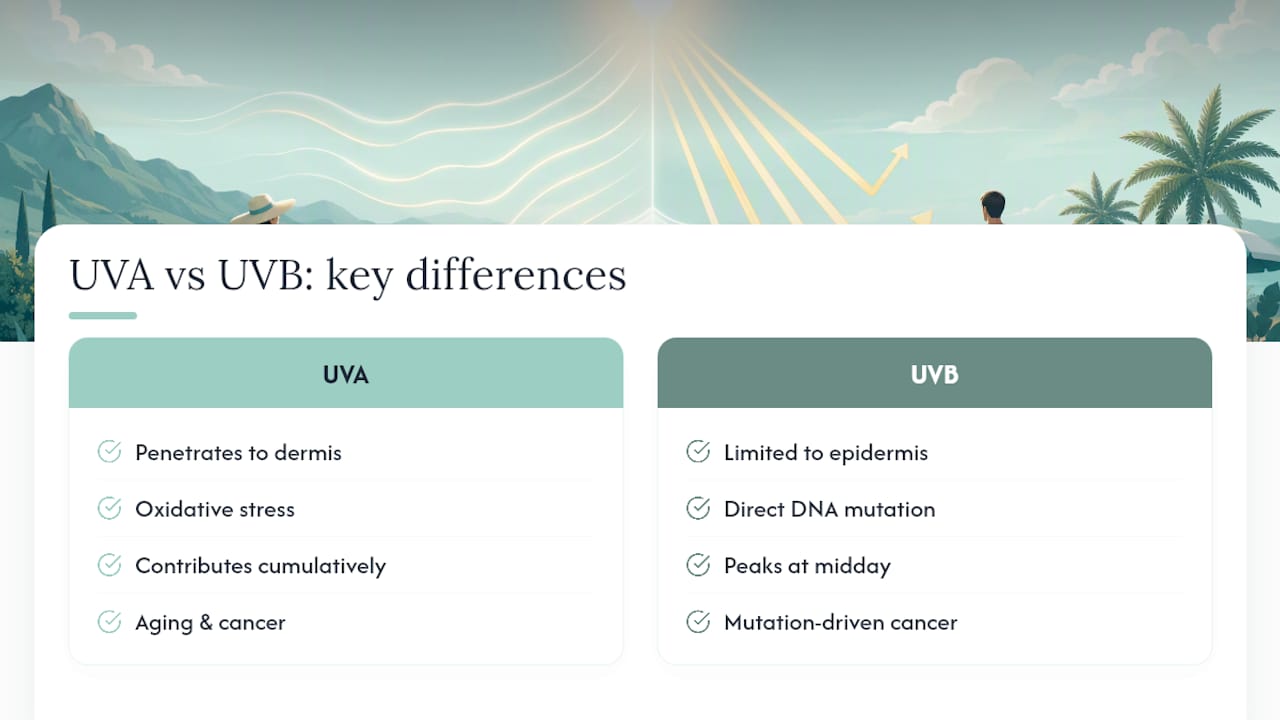
A tan is proof of that damage, not evidence you’ve built up protection. The Skin Cancer Foundation is direct about this: tanning is a visible sign of skin injury, and there is no such thing as a safe version of it.
The UV Index, reported daily by weather services, gives you a practical read on total risk. It factors in time of day, cloud cover, and location, so checking it before you plan outdoor time works better than guessing from how hot it feels. Heat and UV strength aren’t the same thing, and a mild, overcast day can still carry a high index.
How to Actually Protect Your Skin From Both Rays
“Broad-spectrum” is the term you’re looking for on a sunscreen label, and it isn’t marketing fluff. FDA guidance requires products to earn that label by passing tests for both UVA and UVB protection, not just UVB. Since SPF only reflects the UVB side, skipping the broad-spectrum check means you could be buying a product that leaves UVA coverage out entirely.
Application matters as much as the product itself:
- Apply sunscreen about 30 minutes before you head outside, giving it time to bind to skin; for detailed safety tips, see when to use sunscreen on a tattoo.
- Use roughly a shot glass amount for full-body coverage, more than most people guess
- Reapply every two hours, and immediately after swimming or heavy sweating
- Layer sunscreen correctly with other body products so it isn’t diluted or blocked
- Choose SPF 30 for daily wear or SPF 50 for longer outdoor stretches
Mineral formulas built on zinc oxide or titanium dioxide sit on top of skin and physically deflect both UVA and UVB. Chemical formulas absorb UV energy and convert it to heat, and they tend to feel lighter, though some people find them more irritating on sensitive skin. Neither type works without reapplication, and clothing rated for UPF, wide shade, and sunglasses all pick up slack that sunscreen alone can’t cover, especially during peak midday hours.
Pro Tip: Most people miss spots that see just as much sun as the face: the tops of ears, the back of the neck, and the tops of feet in sandals. Sunscreen also breaks down under prolonged UV exposure, which is the real reason the two-hour reapplication window exists, not just sweat or water washing it off.
Common UV Myths That Get People Burned
A handful of assumptions cause more sun damage than most people realize:
- “Clouds block UV.” They don’t stop UVA in any meaningful way, and overcast days still carry real burn risk.
- “I’m safe in the car or by a window.” Glass filters some UVB but lets most UVA through, which is why drivers often develop more sun damage on the side of the face nearest the window.
- “A base tan protects me.” A tan offers minimal, unreliable protection and signals damage has already happened.
- “Tanning beds are safer than the sun.” They’re not; most concentrate UVA output and carry the same cancer risk pathway.
- “I get all my vitamin D from sun, so sunscreen is a problem.” Vitamin D synthesis depends mainly on UVB, and most people can meet their needs through diet or supplements without relying on unprotected exposure.
— Ayssa
What UVA and UVB Do to Your Eyes
Skin gets most of the attention in sun-safety conversations, but eyes take direct UV exposure too, and the damage is cumulative in the same way. UVB is the primary driver of photokeratitis, a painful, sunburn-like injury to the cornea that shows up within hours of intense exposure, most often on snow, water, or high-altitude terrain where reflected UVB is strongest. Symptoms include grittiness, redness, tearing, and temporary sensitivity to light, and while it typically clears within a day or two, repeated episodes add up.
UVA plays the longer game here. Like it does in skin, UVA penetrates deeper into the eye and contributes to cataracts, a clouding of the lens that develops over decades of exposure rather than after a single afternoon. It’s also linked to pterygium, a growth on the surface of the eye common in people with heavy lifetime sun exposure, and it factors into some forms of macular degeneration.
Sunglasses are the equivalent of broad-spectrum sunscreen for your eyes, but only if the label actually says so. Look for “100% UV protection” or “UV400” on the lens tag; a dark tint alone tells you nothing about UV filtering, since some dark lenses block little UV at all. Wraparound styles or wide frames add a real benefit by cutting exposure from the sides, which straight-on lenses miss entirely.

Reading a Sunscreen Label for Real UVA and UVB Coverage
The SPF number on a bottle is the most visible spec and also the most misunderstood one. It measures UVB protection only, calculated from how long it takes protected skin to burn compared to unprotected skin. It tells you nothing on its own about UVA coverage.
In the United States, the phrase to look for is “broad-spectrum.” The FDA only permits that label on products that pass testing for both UVA and UVB protection, which makes it the single most important word on the bottle after the SPF number itself. A high SPF without that phrase means strong burn protection and an unknown gap on UVA.
Outside the US, label systems get more specific about UVA strength. The PA rating, common on products sold in parts of Asia, uses a scale from PA+ to PA++++ to indicate relative UVA protection, with more plus signs meaning stronger defense. Some European products carry a UVA circle logo indicating the product meets a minimum ratio of UVA to UVB protection relative to its SPF. American shoppers won’t typically see either symbol, which is exactly why “broad-spectrum” carries so much weight on labels sold domestically.
Whatever system a label uses, the ingredients list backs it up. Zinc oxide and titanium dioxide cover a wide UV range on their own. Avobenzone is the most common UVA-specific chemical filter in American formulas, so seeing it on the label is a reasonable secondary check that a product is doing more than just guarding against burn.
Does Your Skin Type Change How Much UVA and UVB Protection You Need?
Skin tone affects how fast damage becomes visible, not whether damage happens at all. The Fitzpatrick scale, the dermatology standard for classifying skin’s natural UV response, ranges from Type I (very fair, burns easily, rarely tans) to Type VI (deeply pigmented, rarely burns). Higher melanin levels absorb and scatter more UV energy, which is why deeper skin tones burn less easily and show visible photoaging later.
That protection is partial, not complete. Melanin blocks some UVB effectively but does far less against UVA, so people with deeper skin tones still accumulate UVA-driven collagen damage and still carry real skin cancer risk, even though it’s often diagnosed later and at a more advanced stage because it’s expected less. Fair skin, by contrast, burns fast under UVB and shows UVA-driven aging earlier, which at least makes the damage harder to ignore.
Certain conditions and medications shift sensitivity regardless of tone. Rosacea and melasma both react strongly to UVA specifically, often worsening with the kind of incidental daily exposure that comes through windows or on cloudy days. Some antibiotics, acne medications, and retinoids increase photosensitivity to both bands at once, which is worth a conversation with a pharmacist or dermatologist any time a new prescription enters the mix. No skin type gets a pass on broad-spectrum protection; the risk profile shifts, but it never disappears.
Where Miamibeachbum Fits Into the Sun-Protection Picture
Body care should be built around one fact: sun damage is cumulative, and daily habits matter more than any single big beach day. That’s the same principle behind avoiding common sunscreen application mistakes and protecting frequently exposed areas like hands and arms that get skipped in a quick routine. Reef-safe formulas and body-first thinking come from treating broad-spectrum protection as a daily habit, not a beach-day afterthought.
Product Spotlight: Blocked SPF50 for Broad-Spectrum Body Protection
Everything above points to the same conclusion: sunburn protection alone isn’t enough, and neither is a sunscreen you only remember on vacation. Blocked SPF50 is Miamibeachbum’s mineral body sunscreen, built for exactly the daily, full-coverage use this article recommends rather than a once-a-summer application.
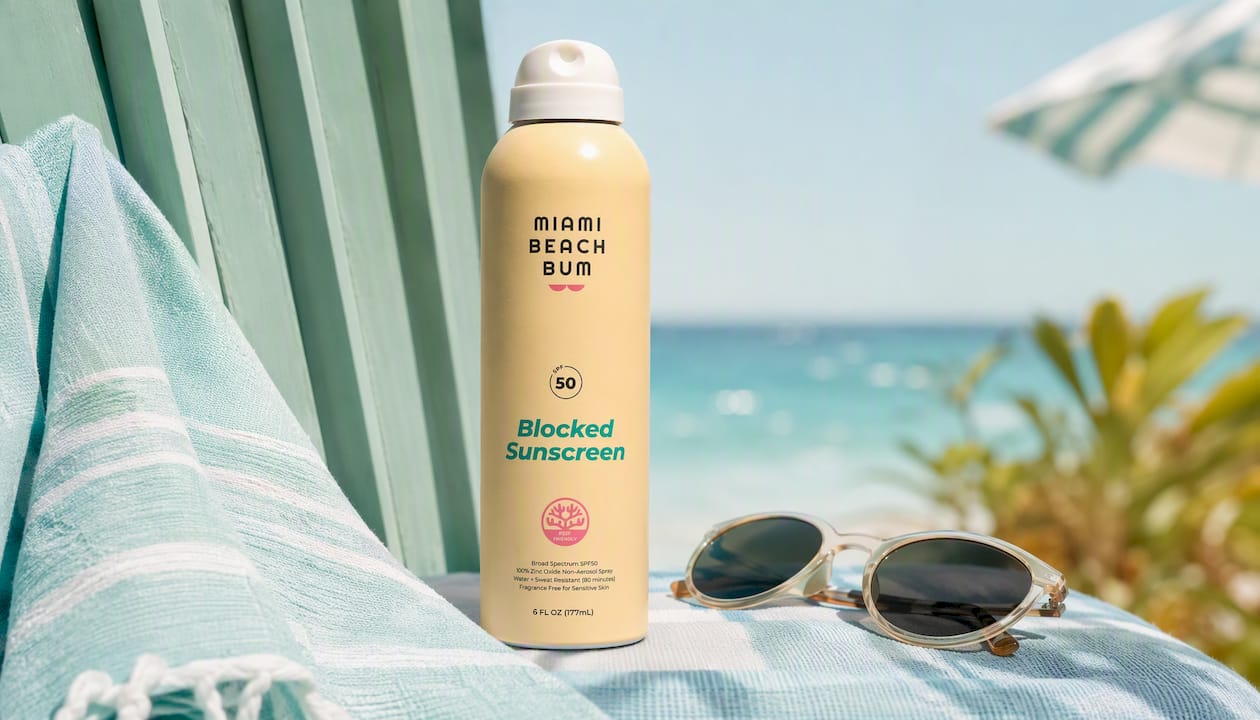
It’s built for anyone who wants body coverage that holds up through reapplication, whether for a beach afternoon, a hike at elevation where UVB runs stronger, or a regular outdoor routine where UVA exposure quietly adds up. Pair it with the timing habits covered earlier: on 30 minutes before exposure, reapplied every two hours, and refreshed immediately after water or heavy sweating. Check out Blocked SPF50 and build it into your next outdoor plan.
Sources
- Radiation: Ultraviolet (UV) radiation — WHO
- Sunscreen: How to help protect your skin from the sun — FDA
- What’s the difference between UVA and UVB rays? — MD Anderson
- Ultraviolet (UV) radiation — Skin Cancer Foundation
These sources back the claims throughout this piece and are worth a direct read if you want the full detail behind any single point.