


Topical self-tanners containing dihydroxyacetone (DHA) are generally considered low-risk during pregnancy when applied as a lotion, cream, or foam. The active ingredient reacts with dead skin cells on the surface and shows minimal systemic absorption. That said, pregnancy-specific safety data are limited, so checking with your OB/GYN or dermatologist before use is the right call.
- Do: Use lotion, cream, or foam formulas applied by hand in a ventilated space.
- Don’t: Use spray tans, aerosol mists, or airbrush booths. Avoid tanning pills and injections entirely.
- Check the label: Look for retinoids, parabens, phthalates, or oxybenzone and avoid products that contain them.
- When in doubt: Consult your prenatal care provider, especially in the first trimester or if you have sensitive or broken skin.
Key Takeaways
Topical DHA self-tanners are considered low-risk during pregnancy when applied as a lotion or cream with proper precautions, but spray tans and tanning pills must be avoided entirely.
| Point | Details |
|---|---|
| Topical DHA is low-risk | DHA reacts only with dead surface skin cells; systemic absorption is minimal per NCBI data. |
| Spray tans carry inhalation risk | Aerosolized application can be inhaled or contact mucous membranes; avoid spray booths entirely. |
| Check the full ingredient list | Retinoids, parabens, phthalates, and oxybenzone are higher-risk additives to avoid during pregnancy. |
| Patch test before full application | Apply to the inner forearm 24–48 hours ahead; pregnancy increases skin sensitivity. |
| Self-tanner is not sunscreen | Always apply broad-spectrum SPF 30+ on exposed skin; fake tan provides zero UV protection. |
Tanning pills and injections are not FDA-approved and are never safe during pregnancy.
Table of Contents
- What authoritative sources say about self tanner use in pregnancy
- Key ingredients explained: what DHA does and what to avoid
- Why spray tans and aerosol application are risky during pregnancy
- How to apply self-tanner safely during pregnancy
- When you should check with your OB/GYN or dermatologist first
- Safer alternatives and why self-tanner is not sunscreen
- Clinician-sourced tips and questions to ask your provider
- An editorial perspective on self-tanning during pregnancy
- Sources
What authoritative sources say about self tanner use in pregnancy
The core of the safety case for topical self-tanners rests on one well-established fact: DHA does not penetrate living skin tissue in any meaningful amount. According to NCBI Bookshelf, DHA acts on the outermost layer of dead skin cells and systemic absorption is negligible. That mechanism is why dermatologists and OB/GYNs generally allow topical use with sensible precautions.
The limitation is real, though. Most available data come from cosmetic toxicology reviews, not controlled pregnancy outcome studies. No large-scale clinical trial has tracked fetal outcomes specifically tied to self-tanner use. MotherToBaby notes that DHA has been used in cosmetics for decades without reported pregnancy problems, but also states clearly that direct pregnancy safety data are limited and that clinician discussion is advisable when in doubt.
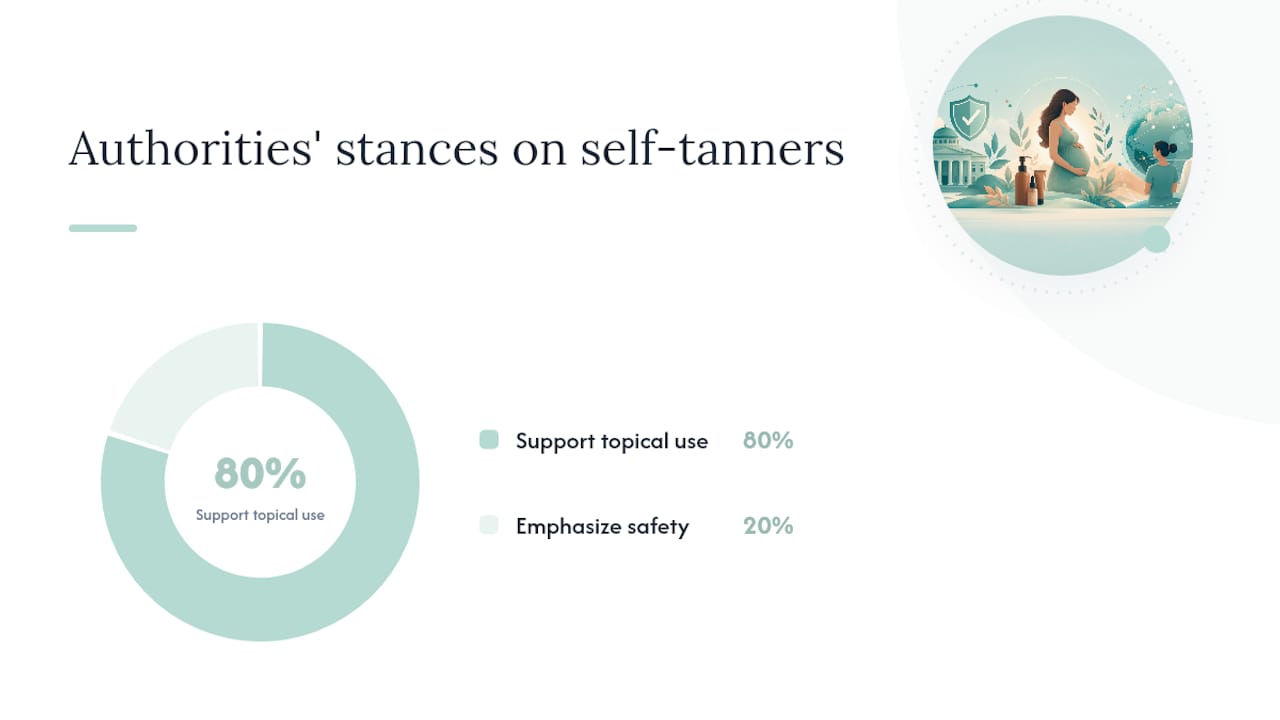
The table below maps each major authority to its practical position.
| Authority | Practical stance |
|---|---|
| NCBI / MotherToBaby | Topical DHA use is acceptable with caveats; patch test and consult your provider |
| FDA | DHA is approved for topical use only; not approved for inhalation or internal exposure |
| American Cancer Society | Avoid tanning pills and spray inhalation; topical products are lower-risk |
| Rady Children’s Health | Topical self-tanners are a safer choice than UV tanning; avoid pills and injections |
| CDC | Avoid overheating outdoors; use sunscreen regardless of tanning method |
Some clinicians advise extra caution in the first trimester, when organogenesis is active and many providers prefer to minimize any unnecessary chemical exposure. That is a reasonable, conservative position. If your provider recommends waiting until the second trimester, that guidance takes priority over any general article.
Key ingredients explained: what DHA does and what to avoid
DHA (dihydroxyacetone) is the active ingredient in nearly every self-tanner on the market. It is a simple sugar derived from plant sources like sugar beets or sugar cane. When applied to skin, it reacts with amino acids in the stratum corneum, the outermost layer of dead cells, producing a brown color through a process called the Maillard reaction. The color develops over two to four hours and fades as those dead cells shed naturally. Because the reaction stays at the surface, the FDA confirms that DHA is intended for topical use only and should not contact mucous membranes.
Erythrulose is a second sugar often paired with DHA in gradual tanners. It works through the same surface mechanism and carries a similar safety profile. Products combining both tend to produce a more even, longer-lasting color.
Where the risk picture changes is with the other ingredients in the formula. Clinicians and dermatologists consistently flag the following additives as ones to avoid or scrutinize during pregnancy, per guidance from Romper’s pregnancy-safe self-tanner review:
- Retinoids (retinol, retinyl palmitate, retinoic acid): Vitamin A derivatives are associated with fetal harm at high doses and are widely advised against during pregnancy by dermatologists and OB/GYNs.
- Oxybenzone: A chemical UV filter with potential endocrine-disrupting properties; some providers recommend avoiding it during pregnancy.
- Parabens: Preservatives with weak estrogenic activity; look for “paraben-free” on the label if you prefer to minimize exposure.
- Phthalates: Often hidden in fragrance blends; linked to hormonal disruption in animal studies.
- Triclosan: An antimicrobial additive that has raised endocrine concerns; largely phased out but still present in some formulas.
- Formaldehyde-releasing preservatives (DMDM hydantoin, imidazolidinyl urea): Potential irritants with systemic absorption concerns.
- Strong synthetic fragrances: Pregnancy heightens skin sensitivity and fragrance reactions; fragrance-free formulas are a safer default.
What to check on the label: Confirm DHA is the primary active ingredient, verify the product is a lotion, cream, or foam (not an aerosol or spray), and look for explicit “paraben-free,” “phthalate-free,” and “fragrance-free” claims if you want to keep the ingredient list short. A skin prep routine that includes gentle exfoliation and moisturizing also helps DHA apply more evenly and reduces the amount of product needed per session.
Why spray tans and aerosol application are risky during pregnancy
The concern with spray tans is not DHA itself. It is the delivery method. When a self-tanner is aerosolized, fine droplets become airborne and can be inhaled or land on the eyes, nose, and mouth. Those mucous-membrane exposure routes bypass the skin barrier entirely, creating a path for systemic absorption that does not exist with lotion application.
The American Cancer Society advises against spray tanning specifically because of inhalation risk, and the FDA has not approved DHA for inhalation or internal use. That regulatory gap matters during pregnancy, when the threshold for caution is higher.
Dos and don’ts for salon situations:
- Do ask whether the salon offers non-aerosol, hand-applied lotion options in a well-ventilated room.
- Do confirm the technician will avoid your face and any areas with broken skin.
- Don’t use a spray booth or stand-in misting chamber.
- Don’t use bronzing mists or aerosol body sprays as a self-tanner substitute.
- Don’t hold your breath and assume that is sufficient protection in a spray booth.
Pro Tip: If a salon cannot offer a non-aerosol application method, skip the appointment and apply a lotion formula at home where you control the ventilation and application area.
How to apply self-tanner safely during pregnancy
A careful routine reduces risk and improves results. Follow these steps in order.
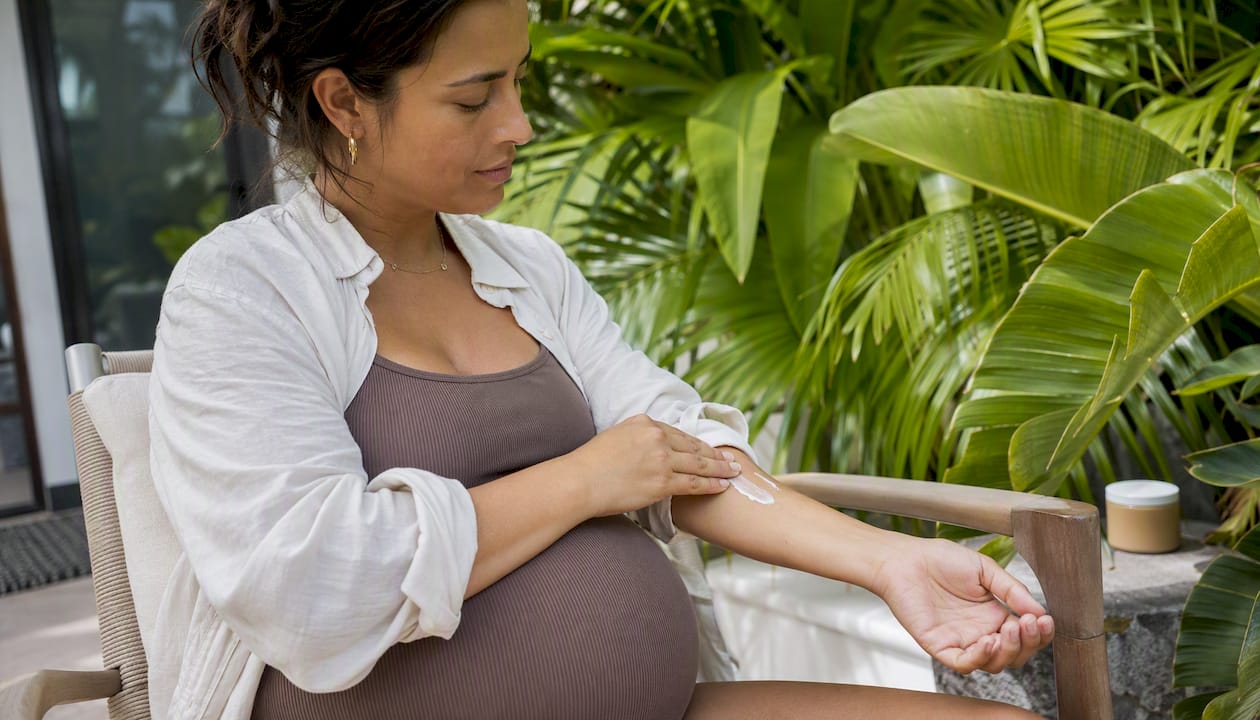
- Patch test 24–48 hours before full application. Apply a small amount to the inner forearm or behind the ear. Pregnancy increases skin sensitivity, so a product you tolerated before may now cause irritation. Check for redness, itching, or swelling before proceeding. WhatToExpect notes that many clinicians allow topical self-tanners with this precaution in place.
- Exfoliate gently. Use a mild scrub or soft washcloth on dry-skin areas (knees, elbows, ankles) the day before application. Avoid harsh physical or chemical exfoliants that could compromise the skin barrier.
- Moisturize dry areas first. Apply a light, fragrance-free moisturizer to elbows, knees, and ankles about 10 minutes before the self-tanner. This prevents the product from pooling and creating dark patches.
- Work in a ventilated room. Open a window or run a bathroom fan. Even lotion formulas contain solvents and fragrance compounds that are better not concentrated in a closed space.
- Wear gloves. Nitrile or latex gloves prevent staining on palms and reduce incidental ingestion if you touch your mouth during or after application.
- Avoid mucous membranes and open skin. Skip the lips, nostrils, and eye area entirely. Do not apply over cuts, active rashes, or eczema patches.
- Use a dedicated facial formula if you want color on your face. Facial self-tanners are formulated for thinner, more sensitive skin and typically carry lower DHA concentrations.
- Wait the full development time. Most formulas need two to four hours to develop. Avoid sweating, showering, or tight clothing during that window.
- Shower and moisturize after development. Rinsing removes residue and reduces prolonged skin contact. Follow with a fragrance-free moisturizer to extend the color and support skin hydration.
- Apply broad-spectrum SPF before going outdoors. Self-tanner provides zero UV protection. A mineral SPF 50 facial serum or a reef-safe body sunscreen should go on top of any bronzed skin before sun exposure.
Accessibility in later trimesters: Reaching the back, lower legs, and feet becomes physically difficult after the second trimester. Ask a partner to apply product to hard-to-reach areas, or use a long-handled applicator mitt to avoid straining or contorting. For tips on managing uneven tone during and after pregnancy, this body-care guide covers practical options.
Pro Tip: Test the patch on your inner forearm rather than a less visible area. Pregnancy hormones can make reactions appear faster and more intensely than before, so the forearm gives you a clear read without risking a visible reaction on your face or chest.
When you should check with your OB/GYN or dermatologist first
Most pregnant people can use a topical self-tanner without a dedicated clinical visit. But certain situations make a quick check-in worth the effort before you open the bottle.
Consult your provider before using a self-tanner if you have:
- First-trimester concerns or a preference for extra caution during organogenesis
- A history of allergic reactions to cosmetics, fragrances, or DHA-containing products
- Active eczema, psoriasis, or any open skin lesions where the product would be applied
- A recent dermatologic procedure such as a chemical peel, laser treatment, or microdermabrasion
- Concerns about a specific ingredient on the label you cannot identify
- Pregnancy-related skin conditions like PUPPP (pruritic urticarial papules and plaques of pregnancy) or cholestasis
What to bring to the appointment or telehealth visit:
- A photo of the full ingredient list (front and back of the product)
- The product name and brand
- The body areas where you plan to apply it
- Any prior reactions to cosmetics or skincare products
This information lets your provider give a specific answer rather than a generic one. MotherToBaby recommends treating self-tanner the same as any cosmetic during pregnancy: patch test, read the label, and bring product information to your prenatal visit if you have questions.
Safer alternatives and why self-tanner is not sunscreen
If you want to skip DHA products entirely, several options give a bronzed appearance without any chemical tanning reaction.
- Tinted body moisturizers and bronzing lotions: These use cosmetic pigments rather than DHA. They wash off at the end of the day and carry no tanning reaction. Ingredient lists tend to be shorter.
- Gradual self-tanning moisturizers: Lower DHA concentrations (typically 1–3%) in a daily moisturizer format build color slowly and are easier to control than a full self-tanner application.
- Makeup bronzers and contouring products: For events or photos, a body bronzer or illuminating powder applied with a brush gives immediate color with no development time and no chemical reaction.
- Clothing choices: A warm-toned outfit or a sheer cover-up can visually warm skin tone without any product application.
The more important point: a self-tan does not protect you from UV radiation. The color change is entirely cosmetic. CDC guidance on skin cancer prevention is clear that sunscreen is required any time skin is exposed to the sun, regardless of how it looks. During pregnancy, UV exposure also raises the risk of overheating, which the CDC flags as a specific concern for pregnant people. Sunbeds and prolonged sunbathing also worsen pregnancy-related hyperpigmentation (chloasma), making sunless options the better choice on multiple grounds, per Rady Children’s Health.
Apply a broad-spectrum SPF 30 or higher every morning on any skin that will see daylight. Reapply every two hours outdoors. The self-tan underneath does not change that math.
For a full picture of how to layer SPF and body care, this body-care routine guide covers the sequencing. For hands-off beauty options during or after pregnancy, postpartum beauty home visit services are worth exploring if you prefer professional application without a spray booth.
Clinician-sourced tips and questions to ask your provider
The practical guidance from dermatologists and OB/GYNs on pregnancy and self tanning products follows a consistent pattern: shorter ingredient lists, no active skincare additives, and fragrance-free formulas when possible.
Clinician-style tips for choosing a product:
- Favor formulas where DHA is the only active ingredient. Products that double as skincare treatments (with added retinol, AHAs, or vitamin C) introduce additional absorption variables.
- Choose fragrance-free when your skin is already reacting to pregnancy hormones. Fragrance is one of the most common contact allergens and pregnancy can amplify that sensitivity.
- Look for “paraben-free” and “phthalate-free” on the label as a baseline filter, per guidance from Romper’s pregnancy-safe self-tanner review.
- Avoid products marketed as “deep” or “dark” tanners for a first-time pregnancy use. Higher DHA concentrations mean more product on the skin; a medium or gradual formula is a lower-exposure starting point.
Questions to ask your OB/GYN or dermatologist:
- “Does this ingredient list look safe for my specific situation?”
- “Should I wait until after the first trimester to use this?”
- “Does my skin condition (eczema, psoriasis, or current rash) make this a contraindication?”
- “Are there any ingredients here that interact with medications I’m taking?”
Pro Tip: For a telehealth visit, screenshot the full ingredient list and send it through your provider’s patient portal before the call. Most providers can scan a label in under two minutes and give you a clear yes or no without a full appointment.
An editorial perspective on self-tanning during pregnancy
The conversation around self tanner pregnancy safety tends to land in one of two unhelpful places: blanket reassurance (“it’s totally fine!”) or blanket avoidance (“don’t use anything”). Neither serves a pregnant person trying to make an informed decision.
The evidence genuinely supports cautious topical use. DHA’s surface-only mechanism is well-established, and decades of cosmetic use have not produced a documented pattern of pregnancy harm. But “no reported problems” is not the same as “proven safe,” and the absence of large controlled studies means the honest answer is “probably fine with precautions, not definitively proven.” That distinction matters when you are making decisions for two.
What gets underemphasized in most articles is the ingredient context. The DHA itself is not the main concern. The retinoids, phthalates, and synthetic fragrances that ride along in many self-tanner formulas carry a more concerning evidence profile during pregnancy than the active tanning ingredient does. Choosing a product is less about finding a “pregnancy-safe self-tanner brand” and more about reading the full ingredient list with the same scrutiny you would apply to a prenatal supplement.
The spray tan question is not a gray area. Inhalation risk is real, the FDA has not approved DHA for internal use, and no salon ventilation system eliminates that exposure route entirely. The conservative call is clear.
At Miamibeachbum, the product philosophy centers on short ingredient lists, reef-safe formulations, and mineral SPF. That same logic applies here: fewer ingredients, transparent sourcing, and sunscreen that actually works are the right defaults during pregnancy and beyond.
Sources
- Sunless tanners (NCBI Bookshelf)
- American Cancer Society — Tanning pills and products
- Rady Children’s Health — Sunless and self-tanning during pregnancy
- MotherToBaby fact sheets
- U.S. Food & Drug Administration — Sunless tanners & bronzers
This article is general information, not a substitute for advice from a qualified doctor. Consult a qualified healthcare professional about your own circumstances before acting on anything here.