


The best ways to reapply spray sunscreen without wrecking your makeup are the damp beauty-blender dab, an SPF mist held 8 to 10 inches from your skin, or a spray-into-hands-then-pat technique for your face. Whichever method you pick, the rule underneath it doesn’t change: reapply regularly while outdoors, and immediately after swimming, sweating heavily, or toweling off.
TL;DR:
- Reapply spray sunscreen with a damp beauty sponge for full coverage, using pressing motions to avoid smearing makeup and ensuring proper product transfer.
- Hold SPF mist 8 to 10 inches from your face, spray in a continuous motion, and air-dry for a minute to prevent under-application.
- Spray into your hands before patting it onto your face to minimize inhalation risks and improve control, especially in windy or crowded outdoor settings.
- Reapply every two hours outdoors, immediately after swimming, sweating heavily, or towel-drying, with approximate amounts of one ounce for full body and one teaspoon for the face and neck.
- Use mineral formulas free of occlusive ingredients for easier reapplication over makeup and on sensitive skin or children, always avoiding spraying directly at the face.
Table of Contents
- How to reapply spray sunscreen with a damp beauty blender
- Can you use an SPF mist to reapply sunscreen over makeup?
- Why spray into your hands instead of directly on your face
- How often should you reapply sunscreen, and how much is enough?
- Spray-sunscreen safety and dermatologist-backed application habits
- Choosing sunscreen formulas that layer over makeup
- Your 6-step midday reapply checklist
- Reapplying spray sunscreen on kids and sensitive skin
- Why Miamibeachbum builds sunscreen for reapplication, not just morning use
- The Miamibeachbum products that fit these reapplication methods
- Where to go for deeper reapplication guidance
- Sources
How to reapply spray sunscreen with a damp beauty blender
Reach for this method when you need real coverage, not just a quick pass, and the wind isn’t fighting you. It takes three to five minutes, which makes it a better fit for a lunch break than a subway platform, but it’s the most reliable way to get an even, makeup-safe layer back onto your face.
The technique works because a damp sponge deposits product with a pressing motion instead of a swiping one. Swiping is what smears foundation and drags concealer out of place. Pressing does not.
Steps:
- Dispense two to three pumps of your sunscreen (or spray it directly) onto the back of your clean hand.
- Dampen a beauty sponge with water and squeeze out the excess so it’s moist, not dripping.
- Press the sponge into the product on your hand to load it evenly.
- Dab in sections, forehead, cheeks, nose, chin, and down the neck, using a bouncing press-and-lift motion rather than a rubbing one.
- Let it settle for two to three minutes before touching your face again or adding powder.
On quantity, dermatologists point to the “glisten” test as the clearest visual sign you’ve applied enough: your skin should show a faint sheen right after application, and if it looks completely matte and dry, you probably under-applied, per the American Academy of Dermatology. For the face and neck specifically, dermatology groups generally point to roughly a teaspoon’s worth as the target, based on guidance from the American Cancer Society.
Not every sunscreen texture cooperates with this method. Lightweight, water-based mineral fluids or gel-creams press into a sponge and blend cleanly. Thick, balm-like sunscreens tend to sit on top of the sponge instead of transferring, and they’re more likely to pill against a matte foundation.
Pro Tip: Load your sponge with slightly more product than feels intuitive. A dry-looking sponge means the sunscreen ends up absorbed by the sponge itself rather than your skin, which is the single most common reason people think this method “doesn’t work.”
If your base makeup already sits close to your skin, a damp-sponge reapplication over an SPF-friendly makeup routine barely registers. If you’re wearing something heavier and full-coverage, expect a slight change in finish, which is normal and fades once the sunscreen sets.
Can you use an SPF mist to reapply sunscreen over makeup?
Yes, and it’s the fastest option on this list, which makes it the natural choice for a work meeting, a train platform, or anywhere you can’t spend three minutes at a mirror. The tradeoff is that mists are easier to under-apply than sponge methods, so technique matters more here than anywhere else.
Hold the bottle 8 to 10 inches from your face, close your eyes and mouth, and sweep it across your skin in a slow, continuous motion rather than a single blast at one spot. Let it air-dry for a minute rather than patting it in immediately, since patting wet mist can smudge liquid liner or fresh lipstick.
A few checks keep this method from becoming a false sense of security:
- Confirm the label lists active UV filters (mineral or chemical), not just “hydrating mist” or “setting spray,” since some setting sprays carry no SPF at all.
- Apply the glisten test after misting, just like you would with any other sunscreen. If your skin looks dry and matte instead of faintly sheened, you didn’t apply enough.
- Go back over any spot that looks dull or patchy with a second light pass, or a gentle fingertip press, rather than assuming one round covers everything evenly.
One detail that trips people up: the difference between a hydrating facial mist and an actual SPF mist is not cosmetic, it’s chemical. If you’re unsure which one you own, it’s worth reviewing what makes an SPF mist different from a hydrating one before you rely on it outdoors.
Dermatology-aligned guidance on spray products in general recommends a six-second spray per body area as a rough heuristic for adequate coverage, since timing alone doesn’t guarantee even application. Translate that to a face mist and you’re looking at several full sweeps, not one quick spritz.
Why spray into your hands instead of directly on your face
This is the method to use on a windy boardwalk, in a crowded outdoor space, or any time you want more control than a mist gives you. Spraying directly at your face means you’re also breathing in a portion of whatever comes out of that nozzle, and dermatology and hospital guidance both flag this as worth avoiding, not worth risking for convenience, according to Houston Methodist.
Spraying into your palms first solves that problem while giving you the same dabbing control as the sponge method, just faster.
- Spray two to three seconds of product into one cupped palm.
- Rub your palms together lightly to spread it evenly without turning it into a thin, patchy film.
- Pat it onto your face in sections, starting at the forehead and working down, avoiding your eyes and mouth.
- Build in light layers rather than one heavy pass, checking for the glisten cue between layers.
Choose this over a full-face mist when you’re outdoors somewhere breezy enough that half your spray would drift past your face entirely, or somewhere crowded enough that spraying toward other people isn’t an option. Choose the damp sponge instead if you have the extra two minutes and want the smoothest possible finish over foundation.
If you have asthma, a respiratory condition, or you’re reapplying on a child, this hands-first approach isn’t just the makeup-friendly option, it’s the safer one across the board.
How often should you reapply sunscreen, and how much is enough?
Every two hours, no exceptions, is the baseline dermatology guidance for anyone spending real time outdoors, according to the Cleveland Clinic. Swimming, heavy sweating, or drying off with a towel resets that clock immediately, even if you applied sunscreen twenty minutes ago.
That immediate reset trips up more people than the two-hour rule itself. Water-resistant sunscreens are only tested to hold up for 40 or 80 minutes in water, and towel-drying physically wipes a portion of that layer off your skin, according to the Skin Cancer Foundation. A “water-resistant” label is not a two-hour label, and it’s definitely not a “skip reapplying after I dry off” label.
The glisten rule, explained: dermatologists use skin sheen right after application as a faster, more reliable gut check than trying to measure sunscreen with a ruler. If your skin looks matte and dry instead of lightly glossy, you almost certainly under-applied.
On amount, the American Cancer Society puts full-body coverage at roughly one ounce, a shot-glass worth, with face and neck alone needing close to a teaspoon. Under-application is common enough that dermatologists specifically call it out as the main reason people think their sunscreen “isn’t working,” per the AAD’s application guidance.
The habit that actually sticks isn’t a rigid two-hour alarm, it’s tying reapplication to something you’re already doing. A few reliable anchor points:
- Reapply right after lunch if you’re outside for the day.
- Reapply the moment you towel off, not “later, once I’m dry.”
- Set a phone timer the second you sit down at the beach or a patio, since two hours goes by faster than it feels.
Spray-sunscreen safety and dermatologist-backed application habits
Spraying sunscreen directly at your face is the habit worth breaking first. Inhaling aerosolized sunscreen particles is a documented concern, which is why the guidance from Houston Methodist is consistent: spray into your hands, or apply in an open, ventilated space, and never spray while inhaling.
Windy days and crowded areas make this doubly true. A gust can carry spray toward your eyes, your mouth, or the person standing next to you, and none of that is protection actually landing on your skin.
Practical safety habits worth building into your routine:
- Never spray directly onto your face. Spray into your hands, then pat it on.
- Apply outdoors or near an open window, not in a closed bathroom.
- Hold your breath or turn your head slightly away for the second it takes to spray your body.
- Rub the product in fully after spraying it onto skin, since sprays don’t self-level the way lotions do, and even coverage depends on you spreading it, per Houston Methodist’s guidance.
That last point matters for your body even when it doesn’t apply to your made-up face. A spray that sits unrubbed on your shoulders or legs leaves streaky gaps, the sunscreen equivalent of a sunburn with a pattern. Over makeup, the fix is different: pat and press instead of rubbing, which keeps foundation intact while still working the product into skin at the edges of your hairline and jaw where sprays tend to pool.
Choosing sunscreen formulas that layer over makeup
The formula you start your morning with determines how much trouble your midday reapplication is going to be. A heavy, occlusive cream under makeup sets you up for pilling by noon; a sheer, fast-absorbing formula sets you up for an easy touch-up.
What layers well:
- Sheer mineral serums with a fluid, almost weightless finish, which sink in fast enough to take makeup right on top.
- Lightweight chemical sunscreen sprays or fluids, which tend to feel closer to a primer than a lotion.
- Tinted SPF formulas containing iron oxide, which add a layer of visible-light protection that plain mineral or chemical filters don’t cover, useful if you spend time near windows or screens as well as outdoors.
What causes problems:
- Thick, cream-based sunscreens with a heavy occlusive finish, which often pill against silicone-based primers.
- Silicone-heavy sunscreens paired with silicone-heavy primers, since layering two silicone products is a common, avoidable cause of that gritty, rolling texture on your skin by midafternoon.
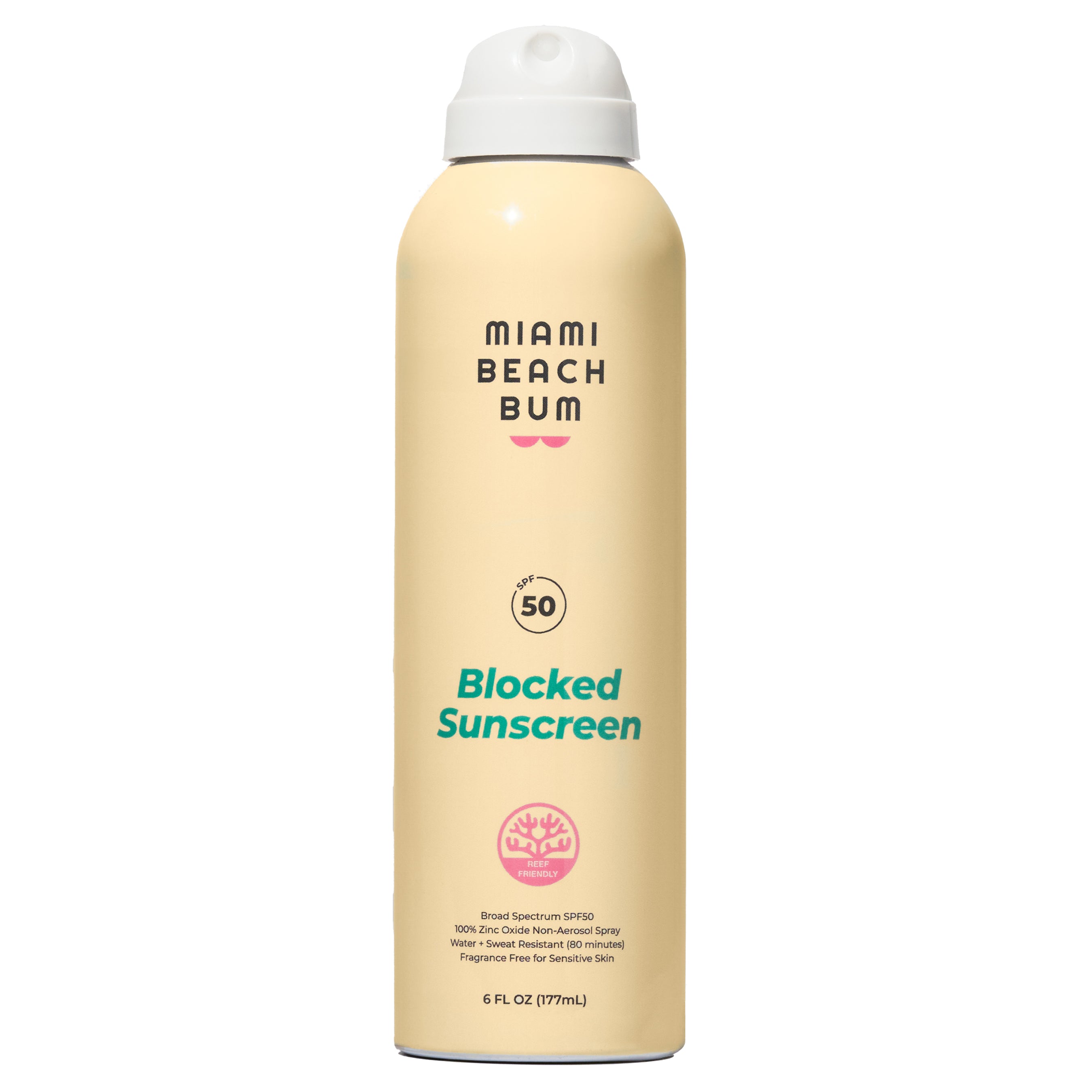
A sheer mineral facial serum, like Miamibeachbum’s Save Face SPF 50 Sheer Mineral Facial Serum, works as a base precisely because it’s built to disappear under makeup rather than sit on top of it, which is what makes the damp-sponge reapplication method painless later in the day. For body coverage that needs the same forgiving texture, Blocked SPF50 follows the same logic without the tint.
Whatever you start with in the morning, the goal is the same: a base that won’t fight your reapplication method eight hours later. If you’re not sure your current combination is doing that, it’s worth a quick check against common sunscreen and skincare layering mistakes before you build a whole routine around a formula that pills.
Your 6-step midday reapply checklist
- Check the time. If it’s been close to two hours, or you just swam, sweated, or toweled off, reapply now.
- Pick your method. Damp sponge for full coverage, mist for a fast pass, spray-into-hands for wind or crowds.
- Apply until you see a glisten, or use the paced dose (a teaspoon for face and neck) rather than a single quick pass.
- Let it dry for a minute or two before adding powder or touching your face.
- Set your next reminder right now, don’t wait until you’re already burned or two hours have quietly passed.
- Reapply immediately after any swim, sweat session, or towel-dry, regardless of when your timer says.
Pro Tip: Don’t inhale spray, and don’t rub over set makeup, pat or press instead. Those two habits alone prevent most reapplication mishaps.
Keep Save Face SPF 50 in your bag for face touch-ups and a body spray like Blocked SPF50 for everywhere else, and this checklist takes under a minute to run through.
Reapplying spray sunscreen on kids and sensitive skin
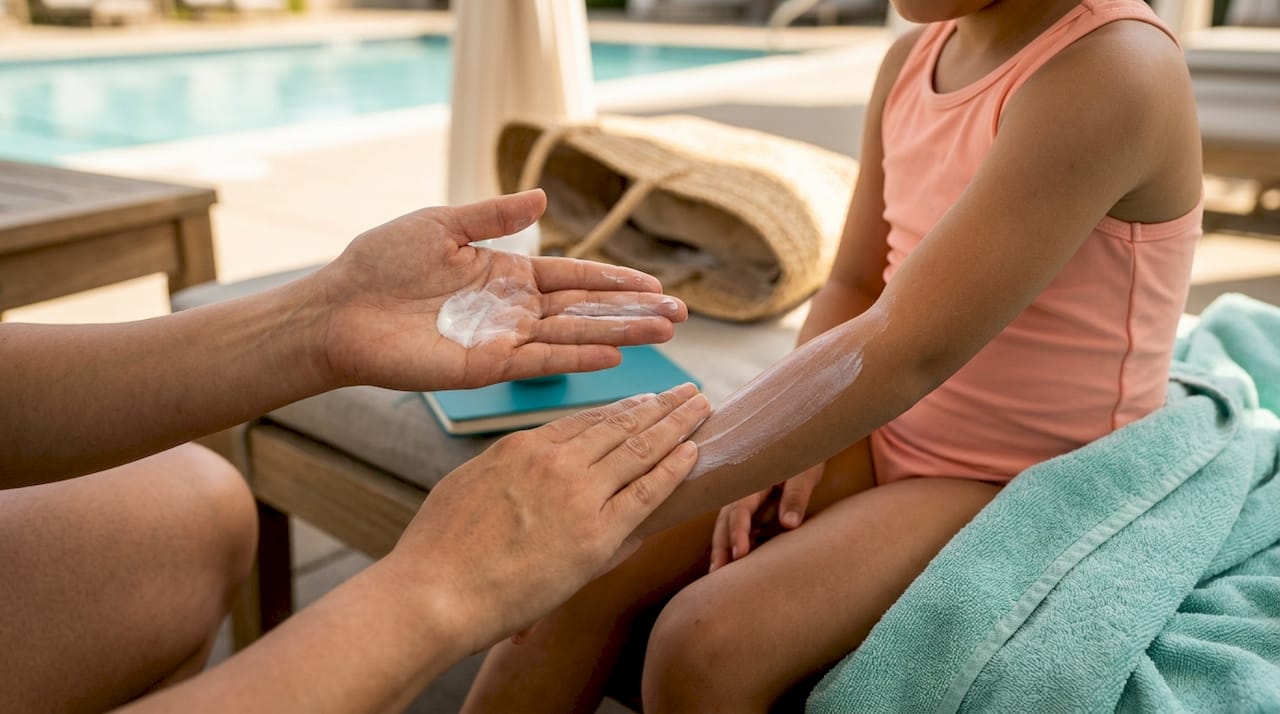
Kids move faster than a spray nozzle can keep up with, which is exactly why the spray-into-hands method is the safer default for reapplying on children rather than direct spraying. A squirming kid and a nozzle pointed at their face is a near-guarantee of getting product in their eyes or a lungful of aerosol they didn’t ask for.
Spray into your own hands, warm the product slightly by rubbing your palms together, then apply it the same way you’d apply lotion, with smooth, even strokes rather than pats. This also gives you a chance to actually see how much coverage you’re getting, which a flailing toddler and a spray bottle rarely allow.
For sensitive skin, whether that’s a child’s or your own, mineral formulas (zinc oxide or titanium dioxide) tend to cause less stinging and irritation than chemical filters, particularly around the eyes where sweat can carry product into delicate skin. If a spray sunscreen has ever made someone’s eyes water on application, that’s a sign to switch to a cream or lotion for the face specifically, and reserve the spray for arms, legs, and torso where irritation risk is lower.
One rule that applies to every use case: never spray directly at a child’s face, and never spray at your own so close that a stray gust could carry it toward your eyes or mouth. Hands first, every time.
Why Miamibeachbum builds sunscreen for reapplication, not just morning use
Most sunscreen advice assumes you’re starting fresh each morning and forgets that the real challenge is hour six, not hour one. That gap between “here’s how to apply sunscreen” and “here’s how to reapply it without destroying three hours of makeup work” is where most guidance quietly stops being useful.
Miamibeachbum’s formulas are built reef-safe and lightweight specifically because a heavy, occlusive sunscreen is nearly impossible to reapply gracefully over set makeup. A sheer texture that plays well with a damp sponge at 8:00 a.m. needs to play just as well with one at 2:00 p.m., and that’s the standard we design against, not just SPF number on a label.
Reapplication isn’t an afterthought to good sun protection and preparing your skin properly can help, as outlined in the Sun Balm Heat Wave offer. It’s the entire second half of it, and it deserves formulas built for that reality specifically.
— Ayssa
The Miamibeachbum products that fit these reapplication methods
Miamibeachbum makes the products this article’s methods were built around, not the other way around. The damp-sponge and spray-into-hands techniques both work best with formulas designed to disappear into skin instead of sitting on top of it, which is exactly the texture profile behind our lineup.
For your face, Save Face SPF 50 Sheer Mineral Facial Serum is built for the damp-sponge dab method specifically, sheer enough to press into a beauty blender without pilling against foundation. For your body, Blocked SPF50 covers full reapplication after a swim or a sweaty walk, while Bum + Body Cream handles spot touch-ups and post-sun skin at the same time, useful for areas like inner thighs or underarms where breakouts and irritation tend to show up alongside sun exposure. If you want to try the full body lineup before committing, the Bodycare Discovery Set is the lowest-commitment way to start. Reapplication only works if the product cooperates with your day, so pick the texture that fits your routine and keep it within reach for the next two-hour mark.
Where to go for deeper reapplication guidance
The reapplication timing and technique covered here draws directly from dermatology and public-health sources, worth bookmarking if you want the clinical detail behind any of these steps:
- Cleveland Clinic: How Often Should You Reapply Sunscreen?
- Skin Cancer Foundation: Sunscreen
- Houston Methodist: Is Spray Sunscreen Actually Effective?
- American Academy of Dermatology: How to Apply Sunscreen
This article is general information, not a substitute for advice from a qualified doctor. Consult a qualified healthcare professional about your own circumstances before acting on anything here.
Sources
- How Often Should You Reapply Sunscreen? | Cleveland Clinic
- Sunscreen | Skin Cancer Foundation
- Is Spray Sunscreen Actually Effective? | Houston Methodist
- How to apply sunscreen | American Academy of Dermatology (AAD)