


Yes, sunscreen expires. Use the printed expiration date, or discard the bottle three years after purchase if there’s no date at all. Toss it sooner, immediately, if the texture, color, or smell has changed. Cool, dry storage stretches a bottle’s effective life, but it can’t override the label once that date has passed.
TL;DR:
- Sunscreens are required to maintain their original effectiveness for three years, but stability testing can extend this shelf life if documented.
- Signs of expired sunscreen include separation, watery texture, graininess, yellowing, and off smells, which indicate it no longer provides reliable protection.
- Proper storage in a cool, dry place and avoiding heat exposure can significantly prolong a sunscreen’s effective life.
- Applying less than one ounce per full-body application or using expired bottles can lead to underprotection during outdoor activities.
- Discard any sunscreen that shows signs of spoilage or has passed the three-year mark, prioritizing new products for maximum UV protection.
Table of Contents
- Does Sunscreen Expire? What the FDA and Doctors Say
- Signs Your Sunscreen Has Gone Bad
- Storage and Handling: Keeping Sunscreen Effective Longer
- How Fast Should You Actually Go Through a Bottle?
- Where Miamibeachbum Fits Into Sunscreen Freshness
- What Expired Sunscreen Actually Does to Your Skin
- Does an Expired SPF Number Still Mean Anything?
- Can You Use Expired Sunscreen in an Emergency?
- Why the “It’s Probably Fine” Habit Needs to Die
- Time to Replace That Expired Bottle
- Sources
Does Sunscreen Expire? What the FDA and Doctors Say
The FDA requires sunscreens to hold their original strength for at least three years unless a manufacturer’s own stability testing proves the formula lasts longer. That three-year window is the federal floor, not a suggestion, and it’s why most sunscreen bottles carry a printed or embossed expiration date somewhere on the packaging.
Finding that date takes a little detective work. Manufacturers often stamp it on the bottom of the bottle or along the crimped seam of a tube, rather than on the front label where you’d expect it. Consumer Reports points out that these markings are easy to miss, especially on travel-size bottles.
If your bottle has no date at all, treat it like a carton of milk with no sell-by stamp. Mayo Clinic recommends writing the purchase date directly on the bottle with a permanent marker the day you buy it.
- Check the bottom of bottles and the crimped edge of tubes for a printed date.
- No date visible? Write the purchase date on the bottle immediately.
- Count three years from that date, then discard, no exceptions for “it still smells fine.”
- Stability data can extend a formula’s life past three years, but you have no way to verify that without a printed date, so default to the three-year rule.
Signs Your Sunscreen Has Gone Bad
Your senses are the fastest test you have, and they’re usually right. The Cleveland Clinic notes that expired sunscreen often shows visible changes in color, smell, or texture well before the calendar date arrives, especially if the bottle has been sitting in heat.
Run through this quick check before you squeeze any product onto your skin:
- Separation. Liquid pooling at the top or bottom of the bottle signals the emulsion has broken down.
- Watery consistency. A lotion that once felt creamy now runs thin between your fingers.
- Lumps or graininess. Clumping means the active ingredients are no longer evenly suspended.
- Yellowing. A shift toward yellow or amber, especially in chemical sunscreens, points to oxidation.
- Off smell. Any sour, rancid, or chemical odor that wasn’t there when you bought it.
Chemical and mineral sunscreens fail in different ways, and that distinction matters for what you’re looking for. Chemical filters like avobenzone or octinoxate can oxidize and turn watery or yellow, which may also increase the chance of skin irritation. Mineral sunscreens with zinc oxide or titanium dioxide tend to separate or turn gritty instead, making them harder to spread evenly, which leaves thin spots with little real protection.
Pro Tip: If a sunscreen fails any one of these checks, don’t try to “use it up anyway.” Applying a broken formula unevenly can leave you with false confidence and real sunburn in the missed spots.
Storage and Handling: Keeping Sunscreen Effective Longer
Heat and ultraviolet light are the two fastest ways to age a sunscreen before its time. Both accelerate the same chemical breakdown that would eventually happen anyway, just years sooner than the label promises. A bottle baked in a car’s glove compartment for a summer can degrade faster than one kept in a bathroom cabinet for three years.
Mayo Clinic advises storing sunscreen in a cool, dry place away from direct sunlight, and that guidance holds whether you’re at home or packing for a beach trip. A few habits make the difference:
- Never leave sunscreen in a hot car, even for a quick errand. Dashboard temperatures can climb past 140°F in minutes.
- At the beach or pool, keep your bottle in a shaded bag or cooler rather than baking on a towel.
- Close the cap fully after every use to limit air exposure, which speeds oxidation in chemical formulas.
- Dry your hands before dipping into a jar-style product to avoid introducing bacteria or water that can throw off the formula.
If you’re spending a full day in the sun and reapplying often, a quick read on why sunscreen breaks down under UV exposure explains the science in plain terms. For water sports specifically, this sun protection guide for surfers covers reapplication timing when you’re in and out of the water all day.
How Fast Should You Actually Go Through a Bottle?
Here’s a test almost nobody runs: if last year’s sunscreen bottle is still sitting in your bag half full, you’re probably not applying enough. The standard guidance calls for about 1 ounce, roughly a full shot glass, to cover exposed skin on an adult body for a single application. That means a standard 4 ounce bottle only holds about four full-body applications.
Do the math across a summer of regular outdoor time, and a properly used bottle should run out in weeks, not linger into next season. Cleveland Clinic dermatologists note that correct daily use means most people should be buying sunscreen more often than they think, not less. If you’re still using a bottle from last year’s vacation, that’s less a sign of a great deal and more a sign you’ve been underapplying all along.
Use these rules of thumb to decide what stays and what goes:
- Replace any bottle at the recommended expiration date, and if undated, discard after a reasonable period such as three years, no matter how much product is left.
- Replace sooner if it’s been stored in heat, direct sun, or a hot car at any point.
- Replace immediately at the first sign of separation, smell, or texture change.
- If a full-size bottle has lasted more than one season of regular use, buy fresh instead of stretching it further.
For a refresher on getting full coverage per application, this guide to spray sunscreen technique breaks down the six-seconds-per-limb method that helps you use the right amount instead of rationing a bottle to make it last.
Where Miamibeachbum Fits Into Sunscreen Freshness
Miamibeachbum built its whole catalog around sun-obsessed body care, which means shelf life and real-world application aren’t afterthoughts here, they’re the point. The brand’s editorial content, including Ayssa’s writing on sunscreen breakdown and layering, exists to help you actually use products correctly rather than let them expire in a drawer.
A few resources worth bookmarking if you want to get more out of every bottle you own:
- Layer sunscreen and body lotion correctly so moisturizer doesn’t dilute your SPF coverage.
- Reapply spray sunscreen over makeup without smudging your look halfway through the day.
- SPF in your daily makeup routine, which covers when a facial product needs replacing faster than a body sunscreen.
Each of these ties back to the same idea: freshness only matters if the application habits around it are solid too.
What Expired Sunscreen Actually Does to Your Skin
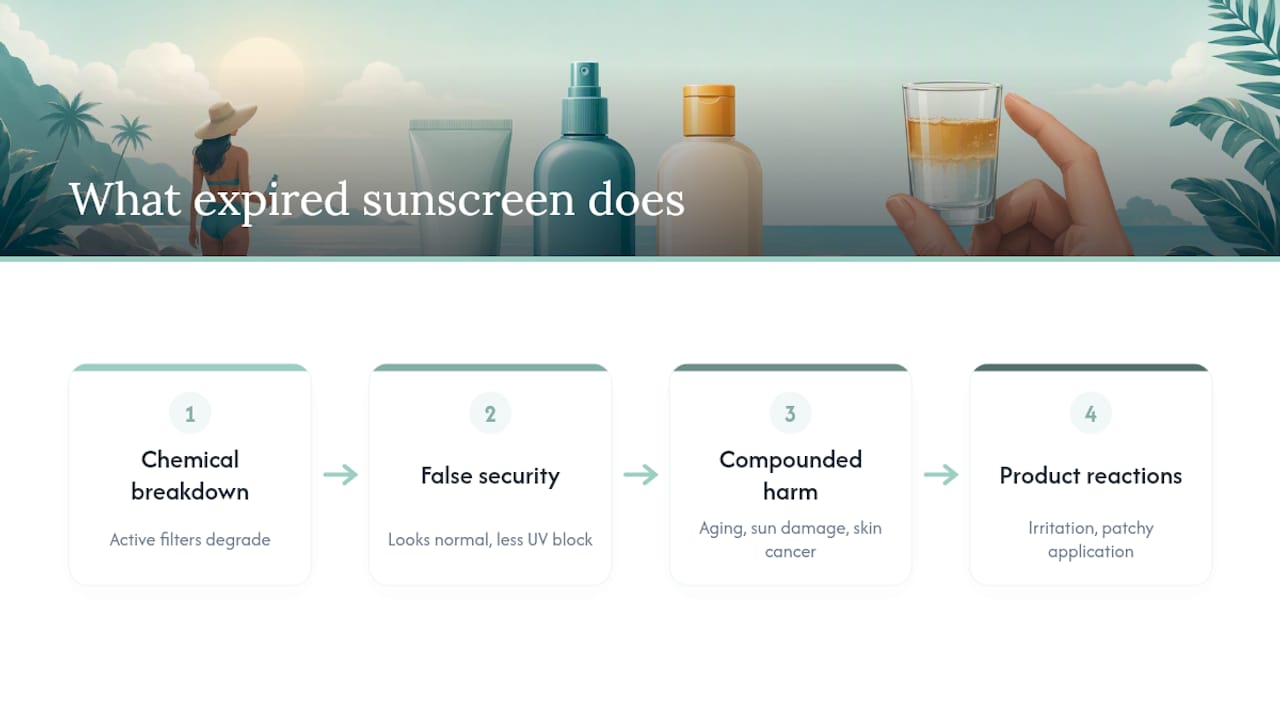
Expired sunscreen doesn’t just stop working gradually, it can fail in ways you won’t notice until the damage is done. The active ingredients responsible for absorbing or reflecting UV rays break down chemically over time, and that breakdown doesn’t announce itself with a dramatic smell every time.
Cleveland Clinic dermatologists consider using expired sunscreen a genuine health risk because degraded active ingredients no longer reliably block UV radiation. The practical result is a false sense of security. You apply what looks and feels like sunscreen, assume you’re covered, and spend hours outside without realizing your actual protection has quietly dropped.
The consequences aren’t limited to a bad sunburn on one trip. Repeated unprotected UV exposure, even in smaller doses over time, contributes to premature skin aging, increased risk of sun damage, and higher long-term skin cancer risk. That risk compounds precisely because expired sunscreen often looks fine on the surface while offering only partial protection underneath.
There’s also a secondary risk worth naming: skin irritation. Oxidized chemical filters can trigger redness, stinging, or allergic-type reactions that have nothing to do with sun exposure and everything to do with the product itself having broken down. Mineral formulas that have separated or turned gritty can cause patchy, uneven application, meaning some areas get real protection while others get almost none.
None of this requires a lab test to catch. It requires believing the calendar and your own senses over convenience.
Does an Expired SPF Number Still Mean Anything?
The SPF number printed on a bottle only holds up as long as the active ingredients inside stay stable. Once those ingredients oxidize, clump, or separate, the SPF rating on the label stops reflecting what’s actually in the bottle. An “SPF 50” that has degraded past its expiration date is not delivering SPF 50 protection anymore, even though the number never changes on the packaging.
Chemical and mineral sunscreens lose SPF effectiveness through different mechanisms, which is part of why the FDA’s three-year rule applies broadly across formula types rather than singling one out. Chemical filters degrade primarily through oxidation, a reaction with air and heat that alters the molecular structure responsible for absorbing UV rays. Mineral filters like zinc oxide and titanium dioxide are more stable chemically, but they rely on being evenly distributed across the skin, so separation or clumping in the bottle translates directly into uneven, weaker coverage on skin.
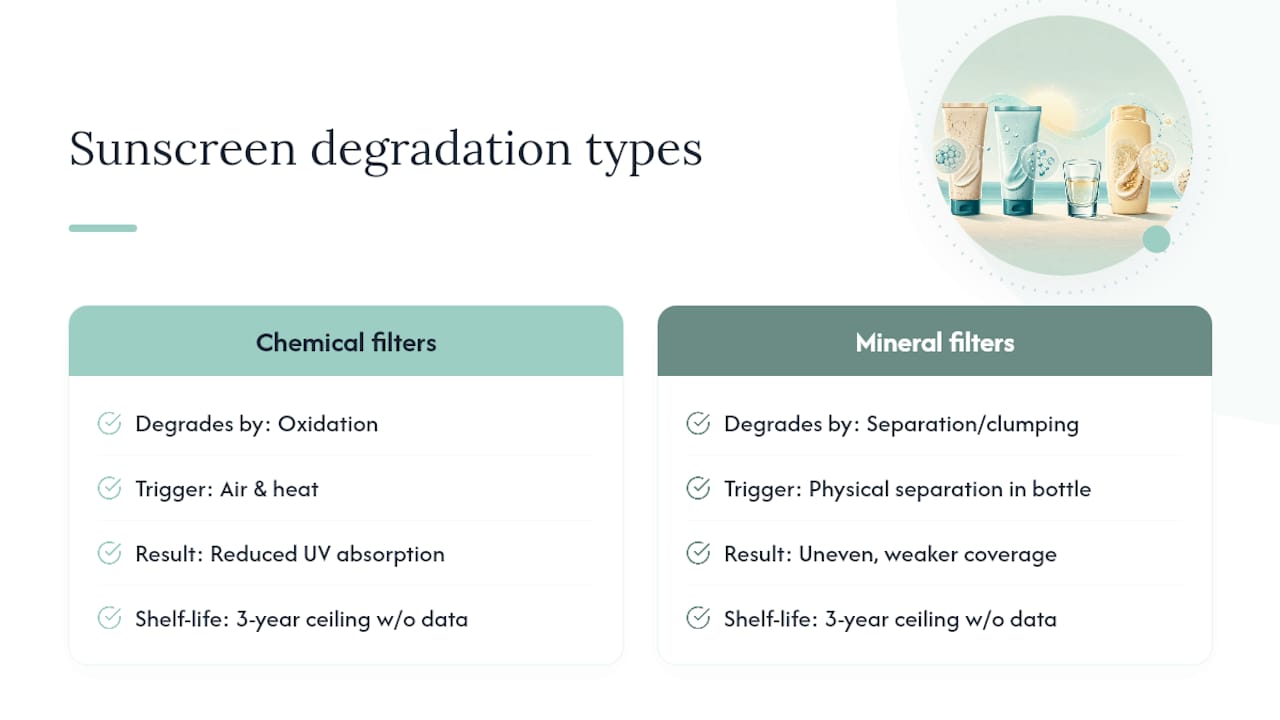
This is also why FDA guidance builds in a mandatory testing standard rather than leaving shelf life to guesswork. Manufacturers can only claim a longer shelf life than three years if they’ve run stability data proving the formula holds its labeled SPF that long. Without that data on file, three years is the ceiling, regardless of how the product looks or smells on day 1,095.
The takeaway is simple: a number on a bottle is only as trustworthy as the chemistry behind it, and that chemistry has a clock running the moment the bottle is manufactured.
Can You Use Expired Sunscreen in an Emergency?
Real talk: if you’re stranded at a trailhead with only an expired bottle and hours of sun ahead, some protection usually beats none. But that’s an emergency exception, not a habit, and it comes with real caveats.
Before using an expired sunscreen even in a pinch, run it through the sensory checks covered earlier. If it smells off, has separated, or shows yellowing or graininess, skip it entirely and rely on physical protection instead, like a hat, long sleeves, and shade. Applying a visibly degraded formula can do more harm than good if it causes irritation on top of offering weak UV coverage.
If the sunscreen is only recently past its date, say a few weeks or months, with no visible or textural changes, it likely still offers partial protection, just not the full labeled SPF. That’s acceptable for a short, low-exposure situation like a quick walk to the car or an overcast afternoon, but it’s not a substitute for fresh product during a full day at the beach or on the water.
The safest rule for low-exposure situations still holds: reapply more frequently and seek shade when you’re relying on sunscreen you’re unsure about. And once you’re back within reach of a store, replace it. An emergency workaround is not a long-term strategy, and treating expired sunscreen as “good enough” for regular use puts you back at the same risk this entire guide is built to help you avoid.
Why the “It’s Probably Fine” Habit Needs to Die
The biggest gap between what people believe and what’s actually true about sunscreen comes down to one habit: treating expiration as a suggestion rather than a rule. Most people would never eat expired deli meat because it “still looks okay,” yet plenty of us will grab last year’s sunscreen bottle off the shelf without a second thought.
What the evidence actually supports is boring but important: the FDA’s three-year rule and the sensory checks covered here aren’t overcautious advice, they’re the minimum standard for a product doing real chemical work on your skin. Conventional wisdom oversells “if it doesn’t smell bad, it’s fine,” and that’s exactly backwards. Chemical degradation in sunscreen often happens invisibly before it happens visibly.
If I had to pick one habit to fix first, it’s the shot-glass rule. Most people aren’t underprotected because their sunscreen expired, they’re underprotected because they’ve never applied enough to need a new bottle in the first place. Fix your application amount, and freshness takes care of itself because you’ll actually run through bottles at a normal pace. Write the purchase date on anything undated, apply a full ounce per session, and let the three-year rule work as the backstop it was designed to be, not your primary defense.
— Ayssa
Time to Replace That Expired Bottle
If your sunscreen failed any of the checks above, cracked separation, an off smell, a texture that’s gone thin or grainy, the fix is straightforward: replace it before your next time outside, not after. Blocked SPF50 from Miamibeachbum is built as a reef-safe mineral formula, which means you’re getting stable zinc-based protection without the oxidation issues that plague aging chemical sunscreens.
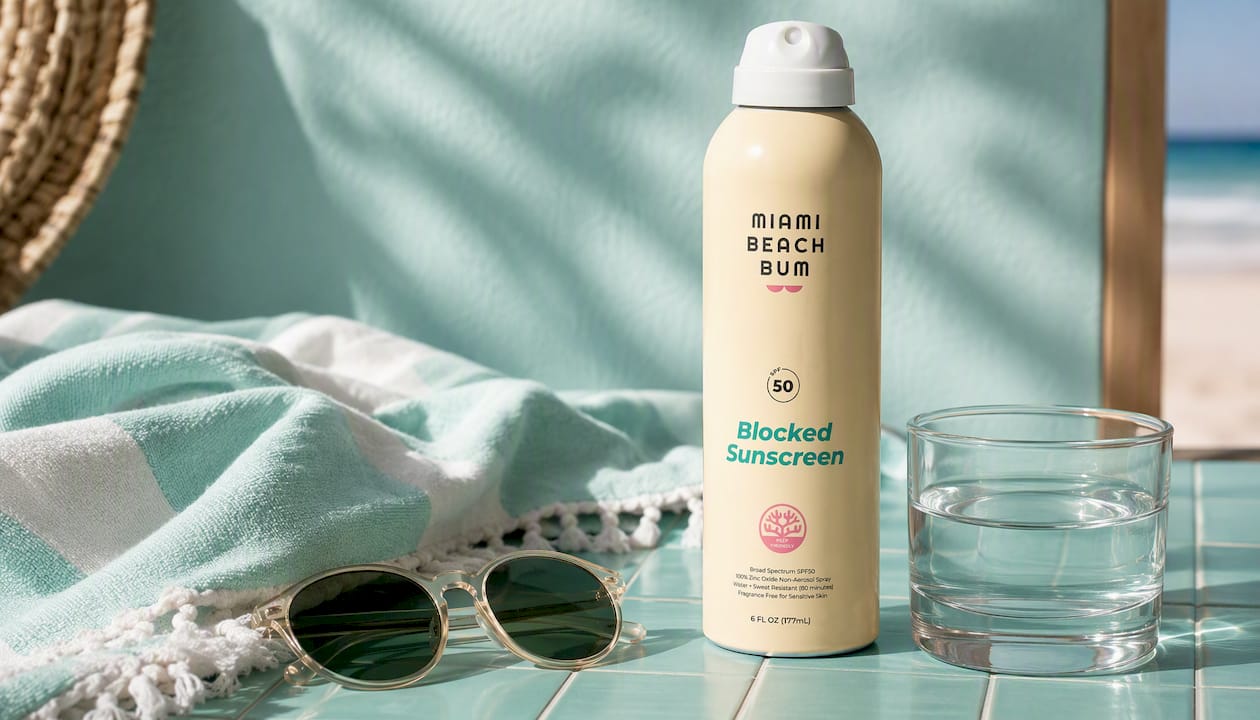
Choosing a replacement comes down to two questions: how much sun exposure are you actually getting, and do you want a mineral or chemical base. If you’re spending real time outdoors, on the water, at the beach, or just walking around in daily sun, a mineral SPF50 like Blocked gives you a wide protection margin without the yellowing or irritation risk chemical filters can develop as they age. Head to the Blocked SPF50 product page to check the formula details and add a fresh bottle to your routine before your next trip outside.
Sources
- Yes, Sunscreen Does Expire — Cleveland Clinic
- Does sunscreen expire? — Mayo Clinic
- Does sunscreen have an expiration date? — Consumer Reports